Grad school is wicked time consuming! This blog is currently on hold as the semester grinds on!

Thursday, June 24, 2010

Exodus 7.8-10.29


Plague Day! Here are the first nine plagues. A plague wrap-up will follow in tomorrow’s post. Warning: this is a long one.
Keep your eye on who is acting in these: Moses alone (Text One) or in combination with his brother Aaron (Text Two).
Aaron’s Miracle: Exodus 7.8-13
The Lord comes to Moses and Aaron and tells them to perform the snake trick (which God previously taught Moses on Mount Horeb in Exodus 4) before Pharaoh. The pair go to Pharaoh and Aaron throws down his staff, which becomes a snake. The Pharaoh summons his sorcerers and magicians to perform the same trick, but their snakes are swallowed up by Aaron’s.

Still, Pharaoh’s heart was hardened, as the Lord said it would be.

What this story tells us might not be so much that God’s magic is real, but rather that it is more powerful than the magicians’. Joseph displays God’s power in interpreting dreams that the Egyptian magicians could not. Likewise, Aaron and Moses demonstrate God’s power with a staff/snake that utterly destroys the magicians’ staff/snakes. The same feats are performed in each, but the Hebrew feat is greater than the Egyptian feat.

Don’t agree with me? By all means, let me know! Check out the comment section below!

The First Plague – Water into Blood: Exodus 7.14-25
There are two interwoven texts for the rest of this analysis.

Text One
Moses is alone for this one. The Lord tells Moses that Pharaoh’s heart is hardened. Therefore, Moses should meet Pharaoh by the river in the morning and remind him of God’s command to “Let my people go, so that they may worship me in the wilderness” (Ex. 7.16). Moses should warn Pharaoh that he will strike the Nile so that it turns to blood, resulting in dead fish, a stinking river, and non-potable water.

Text Two
Then is interwoven the text of a different tradition. This one involves Moses and Aaron. In this version Moses is to tell Aaron to take his staff and stretch his hand over all the water of Egypt, so that all rivers, canals, pools, and ponds become blood. Even the water in vessels of wood and stone will contain blood.

God teaches Moses three tricks in Exodus 4: staff into snake, leprous hand, and water into blood. But the last of these was just some of the water of the Nile, not the entire Nile! Also, this is a different way of doing it. Now the water into blood trick is done with the staff. (Also of note, Moses never uses the second trick.)

When it comes to execution, the two narratives are interwoven. Here I unweave them.[Italics indicate phrases that indicate the text]:
[Text Two] “Moses and Aaron did just as the Lord commanded.”

[Text One] “In the sight of Pharaoh and of his officials he lifted up the staff and struck the water in the river, and all the water in the river was turned into blood, and the fish in the river died. The river stank so that the Egyptians could not drink its water, and there was blood throughout the whole land of Egypt.”

[Text Two] “But the magicians of Egypt did the same by their secret arts; so Pharaoh’s heart remained hardened, and he would not listen to them, as the Lord had said. Pharaoh turned and went into his house, and he did not take even this to heart.”

[Text One? (This one is iffy)] “And all the Egyptians had to dig along the Nile for water to drink, for they could not drink the water of the river.”
Note on magic: the magicians could do the same thing!

Also note that it is the Egyptians who have to dig for water. It is not indicated whether this plague affects the Israelites.

Seven days (a standard designation that does not necessarily mean a week but rather some short period of days) pass so that the river can clear up in preparation for the next plague.

The Second Plague – Frogs: Exodus 8.1-15

Two texts again.

Text One
The Lord tells Moses to got to Pharaoh and tell him the Lord says “Let my people go, so that they may worship me” (Ex. 8.1). God threatens frogs, and their presence will be personal: Though frogs will plague the entire nation, the frogs will come from the river into Pharaoh’s palace, into his bedchamber, into his bed, into the houses of Pharaoh’s officials and the Egyptians.

Text Two
The Lord tells Moses to tell Aaron to stretch out his hand and staff over the rivers, canals and pools. Wait, have we seen this before? Yes, we have. See the first example of this story type in the first plague.

The magicians are able to replicate the plague. 

The frogs affect Egyptians; it is not indicated that the Israelites are affected.
Pharaoh Responds [Text Two]
Pharaoh entreats Moses and Aaron to pray to the Lord to take away the frogs. If the frogs are taken away, Pharaoh will let the Israelites go. Moses tells Pharaoh to tell him when to pray, and it will be done. Pharaoh responds, “Tomorrow,” to which Moses says, “As you say! So that you may know that there is no one like the Lord our God, the frogs shall leave you and your houses and your officials and you people; they shall be left only in the Nile” (Ex. 8.10-11). (From this text, it seems that only the Egyptians are affected by the plague.)

Moses prays to God, the Lord answers Moses’ prayer, and the frogs all die. The frogs are gathered in heaps, and again the land stinks. But again, Pharaoh hardens his heart.

The Third Plague – Gnats: Exodus 8.16-19

Text Two
The Lord tells Moses to tell Aaron, “Stretch out your staff and strike the dust of the earth, so that it may become gnats throughout the whole land of Egypt” (Ex. 8.16). Aaron does so “and the gnats came on humans and animals alike; all the dust of the earth turned into gnats throughout the whole land of Egypt.” (Ex. 8.17).

This time, the plague seems to affect everyone in Egypt, which presumably includes the Hebrews.

The magicians are unable to reproduce this plague. They tell Pharaoh, “This is the finger of God!” (Ex. 8.19). And, indeed, it is one of ten plagues of God’s “mighty hand” that will bring the Israelites out of Egypt.

But Pharaoh’s heart is hardened; he does not listen to his magicians.

The Fourth Plague – Flies: Exodus 8.20-32

Text One
The Lord tells Moses to rise early and find Pharaoh by the water. Moses is to tell Pharaoh to let the Israelites go, so that they can worship God. If this is not done, God will send swarms of flies, a plague just as personal as the frogs, and just like the frogs, affecting only Egyptians: “But on that day I will set apart the land of Goshen, where my people live, so that no swarms of flies shall be there, that you may know that I the Lord am in this land. Thus I will make a distinction between my people and your people” (Ex. 8.22-23). This will happen the next day. 

The distinction that was implicit before is made explicit here. Now we know that the Israelites are protected from the plagues.

The Lord executes his promise, and flies descend upon Egypt.

Text Two
Pharaoh summons Moses and Aaron and tells them to make sacrifices to God. Moses responds that this would be improper: sacrifices to the Lord are offensive to the Egyptians – the Israelites will be stoned if they make sacrifices. They must go three days into the wilderness.

Pharaoh tells Moses they may go, provided they do not journey too far. Moses answers that he will pray to the Lord so that the flies will depart the next day. But Pharaoh should stay true to his word.

Surprise! Moses and the Lord follow through, but Pharaoh’s heart is hardened.  

The Fifth Plague – Livestock Diseased: Exodus 9.1-7

Text One
The Lord tells Moses to go to Pharaoh with the message that Pharaoh should let God’s people go. If not, then “the hand of the Lord will strike with a deadly pestilence your livestock in the field: the horses, the donkeys, the camels, the herds, and the flocks” (Ex. 9.3). But the Lord will make a distinction between the livestock of Egypt and that of Israel. The Lord sets the next day for the plague.

All the livestock of the Egyptians dies, quite a number! But this is not completely correct. The next plagues will contradict this detail.

Pharaoh inquires himself and discovers that the livestock of the Israelites survived. But with his hardened heart, Pharaoh does not let the Israelites go.

The Sixth Plague – Boils: Exodus 9.8-12

Text Two
The Lord tells Moses and Aaron that Moses should take handfuls of soot and throw them into the air before Pharaoh. The soot will spread over Egypt, causing boils on humans and animals.

The magicians cannot respond to this plague because even they are affected by the boils! And still the Lord hardens Pharaoh’s heart.

The Seventh Plague – Thunder and Hail: Exodus 9.13-26

Text One
The Lord tells Moses to present himself to Pharaoh with the message to let God’s people go:
For this time I will send all my plagues upon you yourself, and upon your officials, and upon your people, so that you may know that there is no one like me in all the earth. For by now I cold have stretched out my hand and struck you and your people with pestilence, and you would have been cut off from the earth. But this is why I have let you live: to show you my power, and to make my name resound through all the earth.
 (Ex. 9.14-16)
That there is no one like me is completely true; God has shown himself better than Pharaoh’s magicians (and by extension his gods). But God does not send all his plagues this time. This is just a plague like any of the others.

God here reveals exactly why he has not simply smote Pharaoh and his people: he wishes to reveal his power. And he is not only revealing his power to Pharaoh, but to the world. And he is not only revealing his power to the world, but to all future generations. And indeed, this is the case. God’s plagues, which take up so much space, are a testament to God’s destructive power. In fact, compare this to the stories of creation. Destruction is given a lot more space. You know what receives even more space? Legal matters. Oy. This too shall pass arrive. 

Compare the sentiment to Shakespeare’s Sonnet 18. The poem expresses the same sentiment; it is an ancient idea, after all. It is not the beauty or destruction that survives time, but the tale of it. Perhaps the biblical writers were conscious even of this.

Back to the plague. God promises through Moses “the heaviest hail to fall that has ever fallen in Egypt from the day it was founded until now” (Ex. 9.18). 

God offers reprieve for those who believe God’s word. The message comes with instructions to bring livestock and slaves into a sheltered place. Pharaoh is losing support; some of his officials who fear the word of the Lord secure their possessions. (Hey, wait a minute. Weren’t the livestock all destroyed in the fifth plague? Perhaps that was a bit of an exaggeration.)

God then command Moses to stretch out his hand to heaven. Moses stretches out his staff, and the Lord sends thunder and hail and fire down on Egypt. Notice that Moses is told to stretch out his hand, and the hand becomes synonymous with the staff in the next verse. Also, this command up until this point has been fulfilled by Aaron, not Moses. Moses takes action in this text.

The hail kills everything in the open field, and destroys all the plants in the field. But there is no hail in Goshen.

Text Two
Pharaoh summons Moses and Aaron and declares his guilt, saying he has sinned and that the Israelites are in the right. Pharaoh then promises to release the Israelites. Moses promises to stop the hail, “so that you may know that the earth is the Lord’s” (Ex. 9.29). But Moses knows that Pharaoh and his officials do not yet fear God.

An editorial note states that the flax and barley were ruined, but the wheat and spelt were not, for they grow later. That means no beer for a year!

Moses stops the rain and thunder and hail, but when Pharaoh sees this, “he sinned once more and hardened his heart, he and his officials” (Ex. 9.34).


The Eighth Plague – Locusts: Exodus 10.1-20

Text One
Exodus 10, which begins the tale of the eighth plague, opens:
Then the Lord said to Moses, ‘Go to Pharaoh; for I have hardened his heart and the heart of his officials, in order that I may show these signs of mine among them, and that you may tell your children and grandchildren how I have made fools of the Egyptians and what signs I have done among them—so that you may know that I am the Lord.’
(Exodus 10.1-2)
Again there is the sentiment that God is acting in such an elaborate manner so that the grand story will be told to future generations. The story of the plagues will be passed on – and it is! Of course, as noted before, it helps to have someone around to write down the story so it lasts even longer:
So long as men can breathe, or eyes can see, 
So long lives this, and this gives life to thee.
(Shakespeare’s Sonnet 18; see above)
Text Two
Moses and Aaron go to Pharaoh with a message from God: How long will Pharaoh refuse to humble himself? Let God’s people go! If Pharaoh does not, God will bring locusts into the country that will blanket the land. They will devour everything left in the fields (wheat and felt; see above) and every tree. They will fill the houses of every Egyptian – something that “neither your parents nor your grandparents have seen, from the day they came on earth to this day” (Ex. 10.6). This sentiment is similar to that of the seventh plague. The seventh plague brought the heaviest hail; the eight brings the greatest infestation of gnats.

Pharaoh’s officials tell him that Moses is quite a pain – why not let him into the wilderness? After all, Egypt is already ruined. It is enough to have Pharaoh bring Moses and Aaron back in and tell them they may go into the wilderness. But Pharaoh will not allow all the Israelites to leave along with their livestock: 
The Lord indeed will be with you, if ever I let your little ones go with you! Plainly you have some evil purpose in mind. No, never! Your men may go and worship the Lord, for that is what you are asking.
(Ex. 10.10-11)
Well, this is simply unacceptable.

Text One
Again it is Moses that is commanded to stretch out his hand, which translates to his staff. The Lord whips up an east wind for a day and a night, which brings locusts the next day. The land is black with locusts. The trees, the crops are all ruined.

Text Two
Pharaoh once again summons Moses and Aaron, saying he has sinned against them and the Lord. He asks for forgiveness (“just this once” [Ex. 10.17]) and removal of the locust. The Lord changes the east wind into a west wind, and the locusts are driven into the Red Sea. But once again the Lord hardens Pharaoh’s heart.

The Ninth Plague – Darkness: Exodus 10.21-29

Text One
The Lord commands Moses to stretch out his hand so that there is darkness. Moses stretches his hand out, not his staff, and a “dense” darkness descends for three days. It is so bad that the Egyptians do not move for three days. The Israelites, on the other hand, have plenty of light.

Pharaoh summons Moses and tells him to go worship the Lord. Even the children may go now, but the livestock must be left behind (one senses as collateral). Moses argues the animals are necessary for sacrifices: 
‘You must also let us have sacrifices and burnt-offerings to sacrifice to the Lord our God. Our livestock also must go with us; not a hoof shall be left behind, for we must choose some of them for the worship of the Lord our God, and we will not know what to use to worship the Lord until we arrive there.’
(Ex. 10.25-26)
The Lord hardens Pharaoh’s heart, and Pharaoh cries, “Get away from me! Take care that you do not see my face again, for on the day you see my face you shall die” (Ex. 10.28). Moses replies, “Just as you say! I will never see your face again” (Ex. 10.29).

Actually, Moses will.

Does anyone share my appreciation of the dark humor in that last exchange? In a tale in which Egypt is robbed of its sight, Pharaoh and Moses argue over seeing each other. I hope that is intentional on the author’s part.

Interesting. For this plague there is no introduction about Pharaoh’s heart being hardened or Moses going to Pharaoh. Perhaps God has finally had enough?


Wednesday, June 23, 2010

Exodus 6.1-7.7

Israel’s Deliverance Assured: Exodus 6.1-13

When last we left our hero, Moses was wondering why the Lord so “mistreated” this people, failed to deliver them, and choose Moses as his general go-to guy.

The Lord tells Moses that now he will execute the divine plan. God’s “mighty hand” will force Pharaoh to let the Israelites go (Ex. 6.1, Cf. Ex 3.19-20).

Then comes a story (from a separate tradition) that parallels God’s conversation with Moses is chapters 3 and 4. God again appears to Moses as the God of Abraham, Isaac, and Jacob. But God claims he appeared to these men as “God Almighty,” though by his other name, “The Lord,” he did not make himself know. This is not true. In the composite biblical narrative, God revealed himself as YHWH to all of these patriarchs. In the tradition this story is drawn from, apparently God did not.

God speaks of the covenant of land, leaving out the part about progeny. (Perhaps this has been fulfilled?) In any case, hearing the groans of the Israelites has caused God to remember the covenant. Moses is therefore to tell the Israelites that the Lord has come to free them from slavery: 
I will redeem you with an outstretched arm and with mighty acts of judgment. I will take you as my people, and I will be your God.
(Ex. 6. 6-7)
God will bring the Israelites into the land sworn to the patriarchs and give it over.

In this telling of the tale, Moses does not doubt God or himself. He goes straight to the Israelites and tell him. But this part of the narrative remains the same – the Israelites do not listen, because slavery has broken their spirit.

The Lord tells Moses to tell Pharaoh to let the Israelites go. Moses tells the Lord that if the Israelites will not listen, why should Pharaoh listen to him, poor speaker that he is? The Lord then gives orders to Moses and Aaron regarding freeing the Israelites from Pharaoh.

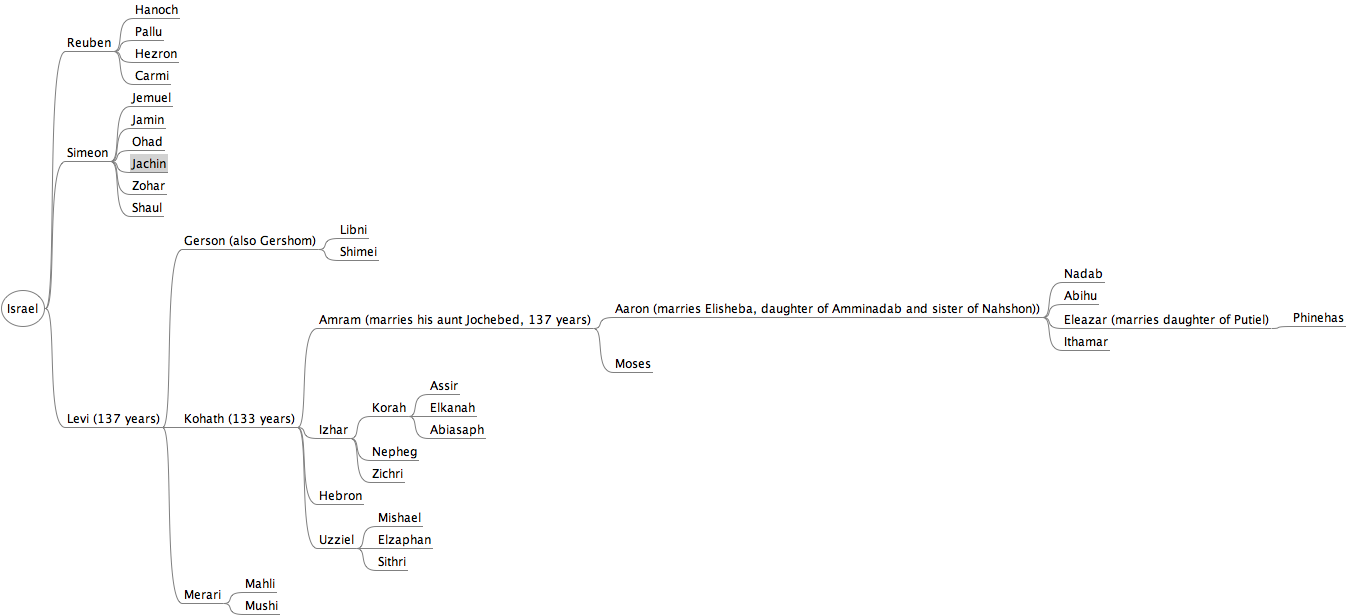
Genealogy of Moses and Aaron: Exodus 6.14-27

Click the image below for today’s genealogy.


Looks a bit like the Starship USS Enterprise, no?

Moses and Aaron Obey God’s Commands: Exodus 6.28-7.7
For the third time in the composite biblical narrative, God comes to Moses and tells him to speak to the King of Egypt. For the third time, Moses asks why Pharaoh should listen to such a poor speaker (literally “poor speaker” here is uncircumcised of lips in Hebrew. That one phrase tells us so much of the view of non-Hebrews and the importance of circumcision as a sign of the covenant.)

Moses is to act as God, and Aaron as his prophet. In effect, every character is displaced one – a game of biblical musical chairs. In confronting Pharaoh, God moves out of the picture, Moses moves up to God’s place, and Aaron moves up to Moses’ place.

God tells Moses that he is to tell Aaron to tell Pharaoh to free the Israelites. But God will harden Pharaoh’s heart so that God may “multiply my signs and wonders in the land of Egypt” (Ex. 7.3). It is frustrating that God insists on hardening Pharaoh’s heart rather than simply freeing the Israelites, but perhaps this passage gives a clue as to why God does so. Maybe God wants to give signs, to make this a memorable occasion. In any case, it will be!

God tells Moses that when Pharaoh does not listen, “I will lay my hand upon Egypt and bring my people the Israelites, company by company, out of Egypt by great acts of judgment” (Ex. 7.4). Then God reveals that the hardening of Pharaoh’s heart is an integral part of his plan: “The Egyptians shall know that I am the Lord, when I stretch out my hand against Egypt and bring the Israelites out from among them” (Ex. 7.5).

When Moses and Aaron do this, Moses is eighty and Aaron is eighty-three.

Check out all the hand imagery! Between Exodus 3.9 and 4.20, the word appears 14 times. It’s the appendage with which Moses carries his staff, and with which God forces Pharaoh to free the people of Israel.

Yesterday’s post emphasized the “dialectical tensions” in the Moses narrative. This is a tale of human recalcitrance. Moses assumes an almost adversarial role against God, not wishing to speak to Pharaoh, not willing to lead the Israelites. Pharaoh, on the other hand, does not have a choice but to act as God’s enemy. Moses has a choice, but God hardens Pharaoh’s heart so that the King of Egypt cannot act any other way.

Tuesday, June 22, 2010

Exodus 4.18-5.23

Moses Returns to Egypt: Exodus 4.18-4.31

Moses returns to his father-in-law Jethro and asks to return to Egypt:
Please let me go back to my kindred in Egypt and see whether they are still living.
(Ex. 4.18)
Jethro allows it. The Lord then appears to Moses and says:
Go back to Egypt; for all those who were seeking your life are dead.
(Ex. 4.19)
These two quotations display a refined authorship: connected by the idea of a return to Egypt, they oppose each other with the dualities of life versus death and kindred versus strangers. There is also a nice sense of justice and finality in the phrase, “those who were seeking your life are dead.”

Moses puts his wife and sons on donkeys and returns to Egypt, staff in hand. (The only son introduced is Gershom; it is likely this is from a different tradition in which Moses has multiple sons.) 

God tells Moses to go before Pharaoh and perform the wonders he has been taught. God will intentionally harden Pharaoh’s heart, so that he will not release the Israelites. It is all part of a plan; Moses is to tell Pharaoh that Israel is the Lord’s firstborn son and should be released so he may worship God. Moses will then warn Pharaoh that God will kill Pharaoh’s firstborn son in retribution.

A Strange Occurrence
On the way, at a place where they spent the night, the Lord met him and tried to kill him. But Zipporah took a flint and cut off her son’s foreskin, and touched his* feet with it, and said, ‘Truly you are a bridegroom of blood to me!’ So he let him alone. It was then she said, ‘A bridegroom of blood by circumcision.’
(Ex. 4.24-26) *Moses’ in the NRSV version, here the Hebrew text preserves ambiguity.
That was a strange passage. Who is “he,” anyway?* Is it Moses or his son? And why would God wish to kill Moses, the man he just designated to lead the Israelites? One theory posits that God attempts to kill Moses or his son because neither are circumcised, having lived outside of the Israelite culture. But does that really merit death?

“Bridegroom” would seem to indicate that it is Moses who is circumcised, but a note in the Harper Collins Study Bible points out that this term was also applied to boys undergoing circumcision. This means that either Moses is saved by the blood of his son’s circumcision or his son is saved by the blood of his own circumcision.

Zipporah does not touch the type of feet you stand on. Feet here is probably a euphemism for genitalia.

*The bible loves puns, and much to the annoyance of those who know me personally so do I. I couldn’t pass up noting that in Hebrew, hu is he. That is, the Hebrew word “hu” translates in English to “he.” Learn more Hebrew from Itche Kadoozy!

The Story Continues
The Lord tells Aaron to meet Moses in the wilderness. They meet at the mountain of God (Hebron; see Ex. 4.14). Moses tells Aaron of God’s plan, and the two go to assemble the elders of the Israelites. Aaron repeats what the Lord has told Moses, performs the signs of Moses, and ends up with a group full of believers:
The people believed; and when they heard that the Lord had given heed to the Israelites and that he had seen their misery, they bowed down and worshipped.
(Ex. 4.31)
Bricks Without Straw: Exodus 5.1-23

Moses and Aaron (without the elders who are supposed to accompany them according to Exodus 3.18) approach Pharaoh and say:
Thus says the Lord, the God of Israel, “Let my people go, so that they may celebrate a festival to me in the desert.”
(Ex. 5.1)
Pharaoh responds, who is this “Lord” (YHWH) guy anyway? I don’t know any Lord. They explain that YHWH, God of the Hebrews, has commanded them to make sacrifice in the wilderness. Otherwise he will deliver pestilence or death. Pharaoh tells Moses and Aaron to get back to work. The Hebrews must continue to work, because they are so numerous.

That day Pharaoh commands the taskmasters and supervisors that they should not give people straw to make bricks. Rather, the Hebrews must go to find the straw themselves – and turn out the same number of bricks. You see, says Pharaoh, “they are lazy,” and that is why they want a break to go worship their God (Ex. 5.8). Therefore their labor should be even greater.

The taskmaster have a chat with the Israelites, who fan out searching fro straw. The supervisors, who are apparently also Israelites, are beaten when the workers do not turn out the same number of bricks. The supervisors approach Pharaoh regarding the unfair working conditions. Pharaoh simply responds that they are lazy and must return to work to produce the same number of bricks. The supervisors realize they are in trouble, and rebuke Moses and Aaron: “The Lord look upon you and judge! You have brought us into bad odor with Pharaoh and his officials, and have put a sword in their hand to kill us” (Ex. 5.21).

Moses, in turn, asks the Lord why the Lord has mistreated the Israelites, and why the Lord sent Moses. The deal has resulted in no good at all, and God has done nothing to deliver the Israelites. It must seem strange to the Israelites. First God comes to kill Moses or his son, and then God increases the workload of the people he wishes to free. Indeed, it must be very frustrating for Moses and the people. God promises something, but does not deliver immediately. Sort of like, oh, the divine promise of land and progeny. Progeny has been adequately fulfilled, apparently, with the family of Israel. But that whole land thing is still a problem. And remember, it took Abraham years to have a son, though he was promised many descendants.

Monday, June 21, 2010

Exodus 3.13-4.17

The Divine Name Revealed: Exodus 3.13-15

When last we left our hero, Moses had been designated God’s ambassador to Pharaoh to bring the Israelites out of Egypt. Moses questioned, “Who am I” to free the Israelites? God promised a sign that God would be worshiped on the same mountain. We now resume the action.

Moses is still doubtful. What should he say to Israelites when he tells them he has been sent by the God of their ancestors and they ask God’s name? God responds,
I am who I am [or] I will be what I will be
(Ex. 3.14)
and 
I am has sent me to you.
(Ex. 3.14)
and
The Lord, the God of your ancestors, the God of Abraham, the God of Isaac, and the God of Jacob, has sent me to you.
(Ex. 3.15) 
and
This is my name forever,
and this my title for all generations.
(Ex. 3.15)
Compare God’s third identification to Exodus 3.6:
I am the God of your father, the God of Abraham, the God of Isaac, and the God of Jacob.
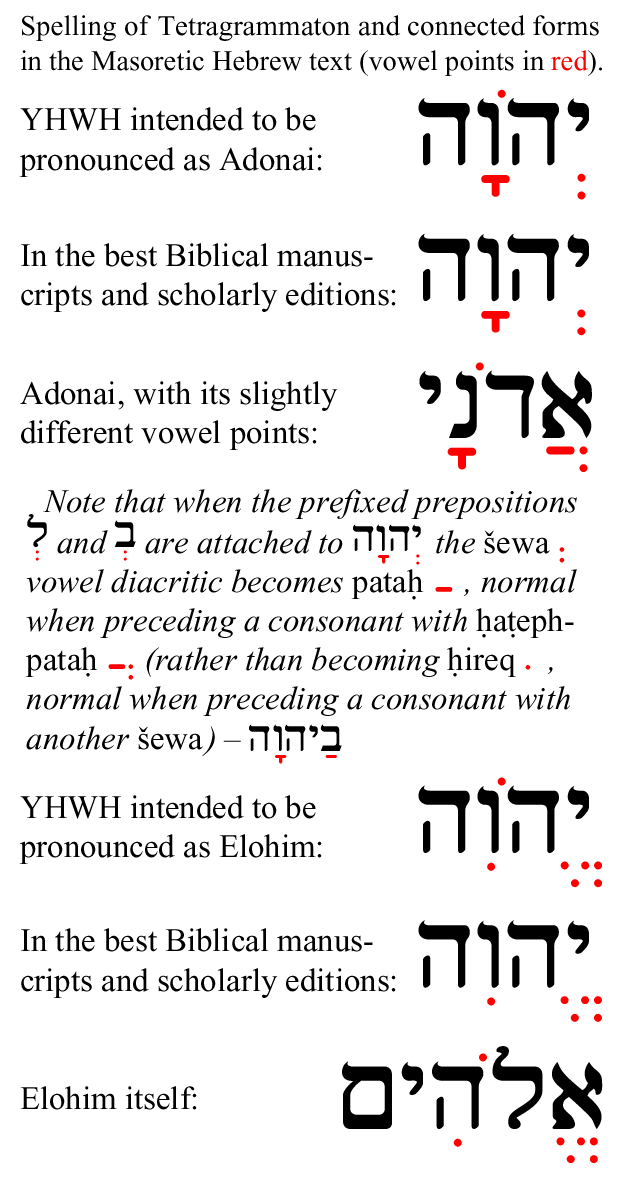
God has many different names, which apparently apply for all eternity: the God of the ancestors, the God that will be, the God that is, and “The Lord.” The last of these has a rich history. The four-letter word, YHWH, which indicates “The Lord” in the bible, is known as “The Tetragrammaton,” which is Greek for “a word with four letters.”

Way back in the day, the Hebrew bible did not have vowels. That’s just how Hebrew was written. The vowels were not inserted until around the end of the first century CE. By the time vowels were added, however, the word was so sacred that people had stopped pronouncing it. (In fact, YHWH not pronounced by observant Jews to this day.) The Tetragrammaton was punctuated with the vowels for adonai, meaning “the/my Lord.” This way people reading the bible aloud would say “adonai” instead of pronouncing that four-letter-word. Whenever you see “The Lord” as a reference to God in the bible, the Hebrew word is adonai, and may or may not obscures the unpronounceable YHWH. 

Those four letters, by the way, are the basis for the Christian terms Yahweh and Jehovah. Also, the Tetragrammaton looks like this, even if it sounds like this.

At this point in the story, differentiating the J and E sources becomes more difficult. Until the revelation of the divine name, a folkloric source that referred to God as “Elohim” (“God” in English) would be identified as E-source, whereas a folkloric source that used “YHWH” (adonai > “the Lord” in English) would be identified as J-source. The revelation of the divine name makes it more difficult to determine which source is which, as both sources afterwards used the term YHWH to refer to God.

One last note on this subject. Though YHWH is God’s “name forever, and…title for all generations,” there is irony in the historical fact that the God’s name is so sacred that it is not even pronounced. The eternal name is transcendent; completely differentiated from this world, not unlike the entity it describes. Sure, God can walk on the Earth, but God is utterly different than humans. Sure, God’s name is (or once was) pronounceable, but it not, because it is utterly different than other words.

All this explanation of a mere three verses! Ah, but just take a look at the commentary on the first sentence of Genesis (Bereishit) by Rabbi Shlomo Yitzhaki, better known as Rashi. He sure knew how to write about the bible!


God Further Commands Moses, Moses Further Doubts: Exodus 3.16-4.17

Long before a doubting Thomas, apparently, came a doubting Moses.

God commands Moses to assemble the elders of Israel and tell them that the ancestral God has come to Moses with word that God has been watching and will bring them out of Egypt to the land of milk and honey (which is occupied by a number of other peoples).

God reassures Moses that the elders will heed him and go with him to the King of Egypt to request a three day’s journey into the wilderness to make a sacrifice to the Lord. God knows that the king will not agree to this “unless compelled by a mighty hand” [in Hebrew: no, not by a mighty hand] (Ex. 3.19). God is just the one to provide the hand that will force Pharaoh’s hand, so to speak:
So I will stretch out my hand and strike Egypt with all my wonders that I will perform in it; after that he will let you go. I will bring this people into such favor with the Egyptians that, when you go, you will not go empty-handed; each woman shall ask her neighbor and any woman living in the neighbor’s house for jewelry of silver and of gold, and clothing, and you shall put them on your sons and on your daughters; and so you shall plunder the Egyptians.
(Ex. 3.20-22)
That is some serious foreshadowing there.

Moses is still uncertain. What if people doubt him? The Lord answers something along the lines of, See that staff in your hand? Throw it on the ground. It becomes a snake, and Moses draws back. Grab its tail. Moses does so, and it becomes a staff again. Anyone who doesn’t believe Moses has some snakes coming at him, courtesy of the ancestral God.

God has Noah put his hand into his cloak. When Moses removes his hand it is leprous, white as snow. A return to the cloak heals it.

And if these two signs are not heeded, God has a trick beyond this mere parlor magic. Noah is to take the water of the Nile, which will pour out onto the dry ground as blood.

But Moses asserts that he is not eloquent. In fact, he is “slow of speech and slow [Heb. heavy] of tongue” (Ex. 4.10).

The Lord reminds Moses that it is the Lord that gives speech to mortals, and has the power to give them speech and sight and hearing or take them away. “Now go,” the Lord says, “and I will be with your mouth and teach you what you are to speak” (Ex. 3.12).

Moses is still wary: “O my Lord, please send someone else” (Ex. 4.13). This kindles the Lord’s anger, but still God is willing for a compromise: 
What of your brother Aaron the Levite? I know that he can speak fluently; even now he is coming out to meet you, and when he sees you his heart will be glad. You shall speak to him and put the words in his mouth; and I will be with your mouth and with his mouth, and will teach you what you shall do. He indeed shall speak for you to the people; he shall serve as a mouth for you, and you shall serve as God for him. Take in your hand this staff, with which you shall perform the signs.
(Ex. 4.14-17)
This is a rather frustrating tale of divine will versus human resistance. God wants to free his people from their bondage in Egypt, but the chosen messenger is extremely wary. This is what scholars refer to as a “dialectical tension.” The relationship between God and God’s people is fraught with these tensions, these dissonances of desires.

We saw this before when Abraham haggled for the righteous (read: Lot and his family) of Sodom and Gomorrah in Genesis 18.16-33. There and here God makes a number of concessions for his chosen people: Moses is given the name, the signs (magic tricks), and the power of speech, which is deferred to Aaron anyway. But finally, God has enough. Moses is commanded to take up his staff, and the conversation ends there.

Even when God offers to do the work for Moses, to put the words into his mouth, Moses wishes not to act as prophet! (Anyone thinking of a similar story? Jonah, perhaps?) The authors of the bible might be asking, “aren’t we all like this?” There are always these dialectical tensions. Following all the commandments of God is difficult. God is willing to make some concessions, but at some point, God lays down the law. This is a remarkably humane portrayal of God. God is personal and even if a bit terrifying, at least accessible. God can be spoken to and reasoned with. God understands that humans can be stubborn. But sometimes, God has to be stubborn himself.

Sunday, June 20, 2010

Exodus 3.1-12

Moses at the Burning Bush: Exodus 3.1-12 

Moses becomes a shepherd for his father-in-law Jethro. Clearly there is more than one Mosaic tradition, as just a few verses ago in Exodus 2:18 we were told that Moses' father-in-law is named Reuel. In fact, his name is Hobab in Numbers 10.29.

Moses' occupation is logical, as shepherding is a distinctly Hebrew vocation. It also foreshadows Moses' future career as "shepherd" over the Israelites, leading the Israelites through the wilderness for forty years. Sure enough, Moses leads his flock [of sheep] "beyond the wilderness" to "Horeb, the mountain of God" [in another traditional called Sinai] (Ex. 3.1). We don't know whether it was known as the mountain of God during Moses' time (or whether Moses was an actual person, for that matter). In any case, the label serves as a hint from the narrator at the divine revelation ahead.

The angel of the Lord appears to Moses in a "flame of fire out of a bush," a blaze that burns without consuming the plant. The sight draws the curious Moses closer, and the Lord calls out to him from the bush, "Moses! Moses!" Moses responds with the classic response, "Here I am" (Ex. 3.4). 

God commands Moses to come no closer and to remove his sandals, for he stands on holy ground. Then God reveals himself:
I am the God of your father, the God of Abraham, the God of Isaac, and the God of Jacob.
(Ex. 3.6)
Moses hides his face, afraid to look at God.

By this point in the story, the leader of the Hebrews apparently does not need to be a son of the previous patriarch, though Moses is at least an Israelite. 

The Lord says that he has seen his people suffering and has come to deliver them from Egypt and the Egyptians "to a good and broad land, a land flowing with milk and honey" which at the time is occupied by a number of other peoples.

God reveals his plan: God will send Moses to Pharaoh to bring God's people, the Israelites, out of Egypt. But Moses is doubtful: "Who am I that I should go to Pharaoh, and bring the Israelites out of Egypt?" (Ex. 3.11). God responds that there will be a sign that it is God who sent him: when Moses leads the people out of Egypt, "you shall worship God on this mountain" (Ex. 3.12).

Saturday, June 19, 2010

Exodus 1.1-2.25


Genealogy: Exodus 1.1-7

Exodus begins with a recap of the names of the sons of Israel who came to Egypt, the total offspring of Israel numbering 70, as per Genesis. The names are: Reuben, Simeon, Levi, Judah, Issachar, Zebulun, Benjamin, Dan, Naphtali, Gad, Asher. These all die after Joseph, with the rest of the generation, “But the Israelites were fruitful and prolific; they multiplied and grew exceedingly strong, so that the land was filled with them” (Ex. 1.7).

The Israelites are Oppressed: Exodus 1.8-22

A new king arises in Egypt, one that doesn’t know Joseph and has a deep distrust of the numerous and powerful Israelites. Fearing that the Israelites will join Egypt’s enemies in a war against Egypt, the king has the Israelites enslaved. The Israelites build the supply cities Pithom and Rameses (not pyramids!) for Pharaoh. This is particularly interesting because Rameses is where Joseph’s family settles in Genesis 47.11. The Genesis reference is an anachronism; clearly it had not been built yet.

The more the Israelites are oppressed, the more they multiply and spread, and the Egyptians become ruthless in their enslavement, with harsh work bricklaying and in the field.

The king says to Shiphrah and Puah, the (presumably Egyptian) midwives to the Hebrews, that they should kill every boy that is born. But because they fear God, they do not kill any children. Rather, they tell Pharaoh that the Hebrew women, unlike Egyptian women, are “vigorous” and give birth without a midwife.

For their fear of God, God gives the midwives families of their own. God also continues to multiply the Hebrews. Then Pharaoh (as he is named at this point) commands his people that every boy born to the Hebrews should be thrown into the Nile, though girls may live.

Birth and Youth of Moses: Exodus 2.1-10

A Levite man marries a Levite woman and the two have a son. The mother hides the child for three months before placing him in a papyrus basket sealed with bitumen and pitch, which she puts in the reeds on the river bank. Notably, this particular word for “basket” only appears one other time in the bible: in the story of Noah (Gen. 6.14). That too was sealed with pitch. That too was placed in water. What happens hear is a little echo of the flood narrative. As all other Hebrew boys are drowning, the child is kept safe in his little ark.

The child’s sister stands at a distance, watching for what happens.

Pharaoh’s daughter comes to bathe in the river, and sees the basket. She sends a maid to retrieve it. When she opens it, Pharaoh’s daughter finds a crying boy inside. Correctly identifying it as a Hebrew, she takes pity on him.

The child’s sister approaches Pharaoh’s daughter and asks if she should get a nurse from among the Hebrew women. Of course, she returns with her own mother, but Pharaoh’s daughter does not know this. Pharaoh’s daughter tells the woman she will pay for the woman to nurse the child. When the child grows up, Pharaoh’s daughter takes him in as her own son. She names him Moses (Hebrew Mosheh, saying “I drew him out of the water” (Ex. 2.10). However, Mosheh literally means “the one who draws out.”)

By this fortuitous trick, the mother is able to raise (and not murder) her own son. Moses, like Joseph, soon finds himself an Egyptian. There is quite a difference in their status, however.

More Envelope Structure
Oh, and check out the envelope structure. Here it is not the same phrase demarking a section (as explored before), but successive phrases. Pharaoh commands the Egyptians, “Every boy that is born to the Hebrews you shall throw into the Nile” (Ex. 1.22). The following section, which focuses on the boy who was saved, ends with Pharaoh’s daughter saying, “I drew him out of the water” (Ex. 2.10). The envelope structure advances the plot, moving from Pharaoh to his daughter and from throwing into the Nile to drawing out.

Moses Flees to Midian: Exodus 2.11-15a

A grown-up Moses goes out to see what his people suffer. He sees an Egyptian beating a Hebrew, “a kinsfolk.” Then he seeks (an unequal degree of) revenge for his kin: “He looked this way and that, and seeing no one he killed the Egyptian and hid him in the sand” (Ex. 2.12).

The next day he goes out and sees a variation of the scene: two Hebrews fighting. He asks the one who is in the wrong, “Why do you strike your fellow Hebrew?” The answer comes, “Who made you a ruler and judge over us? Do you mean to kill me as you killed the Egyptian?” (Ex. 2.13-14). Moses realizes that his murder is known, and when Pharaoh hears of it, he seeks to kill Moses. 

The man who replies to Moses raises a few interesting points regarding Moses’ future. Who made you ruler and judge over us? Well, no one, yet. But in the next scene we will see that it is God that makes Moses the leader of the Hebrews, a “ruler and judge,” if you will. His next question, Do you mean to kill me as you killed the Egyptian, raises the question of how murder shall be dealt with. This will be answered in the sixth commandment in Exodus 20.13: “You shall not murder.” And then there is the whole thing about conquering the land of Canaan…

Parallel Encounter and Typology: Exodus 2.15b-25 

This section parallels an earlier story from the Bible: the marriage story of Jacob and Rachel. Compare these two encounters [Remember: when last we left our hero, Pharaoh sought to kill him…]

Moses
But Moses fled from Pharaoh. He settled in the land of Midian, and sat down by a well. The priest of Midian had seven daughters. They came to draw water, and filled the troughs to water their father’s flock. But some shepherds came and drove them away. Moses got up and came to their defense and watered their flock. When they returned to their father Reuel, he said, ‘How is it that you have come back so soon today?’ They said, ‘An Egyptian helped us against the shepherds; he even drew water for us and watered the flock.’ He said to his daughters, ‘Where is he? Why did you leave the man? Invite him to break bread.’ Moses agreed to stay with the man, and he gave Moses his daughter Zipporah in marriage. She bore a son, and he named him Gershom; for he said, ‘I have been an alien residing in a foreign land.’

Jacob
Then Jacob went on his journey, and came to the land of the people of the east. As he looked, he saw a well in the field and three flocks of sheep lying there beside it; for out of that well the flocks were watered. The stone on the well’s mouth was large, and when all the flocks were gathered there, the shepherds would roll the stone from the mouth of the well, and water the sheep, and put the stone back in its place on the mouth of the well.

Jacob said to them...[here follow many words] But they said, ‘We cannot until all the flocks are gathered together, and the stone is rolled from the mouth of the well; then we water the sheep.’

While he was still speaking with them, Rachel came with her father’s sheep; for she kept them. Now when Jacob saw Rachel, the daughter of his mother’s brother Laban, and the sheep of his mother’s brother Laban, Jacob went up and rolled the stone from the well’s mouth, and watered the flock of his mother’s brother Laban. Then Jacob kissed Rachel, and wept aloud. And Jacob told Rachel that he was her father’s kinsman, and that he was Rebekah’s son; and she ran and told her father.

When Laban heard the news about his sister’s son Jacob, he ran to meet him; he embraced him and kissed him, and brought him to his house. Jacob told Laban all these things, and Laban said to him, ‘Surely you are my bone and my flesh!’ And he stayed with him for a month. [Joseph ends up working for Laban 7 years and receiving Leah for his efforts. He must work another seven for Rachel. And then...well, it would be silly to recount here the epic son-begetting fest that follows.]

So What?
The narrative similarities are as follows: A man travels to a foreign land and finds himself at a well where shepherds are gathered. The man does some task to prove himself to his potential wife - and in the process waters her flock. The woman runs home and tells her family. The dominant male in the family goes out to the man and invites him home. The man agrees to stay with the family and marries the daughter. The daughter bears a son and names him ritually.

These two stories are the same type of story, containing many similar elements. I will explore this phenomenon more in later entries, but for now it is just important to note that these two stories contain a number of similar details, styles, and events. The encounter at the well, which is quite long-winded in Genesis, is fairly laconic in Exodus because the audience is already familiar with the story. Essentially both of these stories are the same, with different characters. Those encountering the stories chronologically within the bible will notice that the stories are very similar. Because of this, the narrator does not have to be quite as specific the second time around - the reader can fill in the details for himself.

Closing and Parallelism: Exodus 2.23-25

The king of Egypt dies, but the Israelites still cry out from under their slavery. Their cries are heard by God.
God heard their groaning, and God remembered his covenant with Abraham, Isaac, and Jacob. God looked upon the Israelites, and God took notice of them.
(Ex. 2.24-25)
There is something special about the way this is written. It has a parallel structure of cause and effect, with a passive action of God (the cause) creating some specific change in God (the effect). When God hears the groaning, it causes him to remember his covenant. When God looks upon the Israelites, it causes him to take notice of them. The passive actions of hearing and looking create the active actions of remembering and taking notice. The effect is poetic:
God heard their groaning,
and God remembered his covenant...
God looked upon the Israelites
and God took notice of them.
The method of parallelism has remained an effective one through the years Check out this selection from John F. Kennedy’s inauguration speech:

[Note: The ellipses indicates that the paragraph continues, but I have cut out the majority of the paragraph to emphasize the parallelism that begins each paragraph, creating a link between all of them] 
To those old allies whose cultural and spiritual origins we share, 
we pledge the loyalty of faithful friends…

To those new States whom we welcome to the ranks of the free, 
we pledge our word that one form of colonial control shall not have passed away merely to be replaced by a far more iron tyranny…

To those peoples in the huts and villages across the globe struggling to break the bonds of mass misery, 
we pledge our best efforts to help them help themselves, for whatever period is required…
The repeating structure is denoted by the phrases “To those / we pledge.” The structure is useful and effective in linking and presenting ideas. In a way, the repeated phrases function as bullet points around which information is arranged. Consider that the next time you are being inaugurated. Or giving a Power Point presentation. Or writing scripture.