My senior year of high school, I took a class called "Holocaust and Genocide Studies." The first period of the day, it started at 7:15 a.m., roughly two hours before teenagers are meant to get up. But I was fascinated by the course. Dr. Buchanan, the teacher, exposed us all to the basest atrocities of humankind and the ravages or war and genocide. A combination of history, literature, psychology, and philosophy, this was one of the few classes that left a lasting impression on me after high school. To know that humankind was capable of so much evil, and that others had endured such suffering... It changed my perspective.
One of the basic questions of the class was a simple ethical quandary: Is it all right for a person to steal a piece of bread to feed his/her starving family? A moral absolutist would assert that it is wrong to steal anything at all, and therefore it is wrong for a person to steal bread, even if his/her family will die as a consequence. The Hebrew Scriptures show us that moral absolutism is not the answer - that stealing depends upon the situation that gave rise to it.
To show partiality is not good -Now, I am only assuming here that I am applying my ideas correctly to the biblical lesson. But this interpretation seems to make the most sense to me.
yet for a piece of bread a person may do wrong.
(28.21)
Teaching
In any case, Proverbs gives us a lot of different teachings on the nature of wisdom and obedience. Unlike most of the text prior to this point, however, Proverbs emphasizes obeying human commands, rather than those of God. God does have a number of rules that are mentioned in Proverbs, but for the most part this is a teacher speaking to a pupil.
If we wish to read God into the bible (that is, place God in a place where he otherwise might not be easily noticed), we may do so by saying that God acts as the undercurrent for the entire book of Proverbs. In fact, obedience to God is stressed a number of times through the phrase "fear of the Lord." This appears every so often, which we might take as a constant subtle reminder that God is omnipresent. [I do not read it this way myself, but it is an interesting thing to think about.]
If we wish for examples, we have all these:
The fear of the Lord is the beginning of knowledge;
fools despise wisdom and instruction
(1.7)
Because they hated knowledge
and did not choose the fear of the Lord,
...
therefore they shall eat the fruit of their way
and be sated with their own devices.
(1.29; 31)
[if you seek and accept the teacher's commandments,]
then you will understand the fear of the Lord
and find the knowledge of God.
(2.5)
Do not be wise in your own eyes;
fear the Lord, and turn away from evil.
(3.7)
The fear of the Lord is hatred of evil.
Pride and arrogance and the way of evil
and perverted speech I hate.
(8.13)
The fear of the Lord is the beginning of wisdom,
and the knowledge of the Holy One is insight.
(9.10)
The fear of the Lord prolongs life,
but the years of the wicked will be short.
(10.27)
In the fear of the Lord one has strong confidence,
and one's children will have a refuge.
(14.26)
The fear of the Lord is a fountain of life,
so that one may avoid the snares of death.
(14.27)
The fear of the Lord is instruction in wisdom,
and humility goes before honor.
(15.33)
By loyalty and faithfulness iniquity is atoned for,
and by the fear of the Lord one avoids evil.
(16.6)
The fear of the Lord is life indeed;
filled with it one rests secure and suffers no harm.
(19.23)
The reward for humility and fear of the Lord
is riches and honor and life.
(22.4)
Happy is one who is never without fear,
but one who is hard-hearted will fall into calamity.
(28.14)
The fear of others [or "human fear"] lays a snare,
but one who trusts in the Lord is secure.
(29.25)
Charm is deceitful, and beauty is vain,
but a woman who fears the Lord is to be praised.
(31.30)
Fear is to be praised, fear causes happiness, fear is good and righteous. Fear's rewards are life and riches. It is good to have fear, but only fear of the Lord.
Teachers
We are told that the fear of the Lord is the beginning of knowledge and wisdom, but we are also told this:
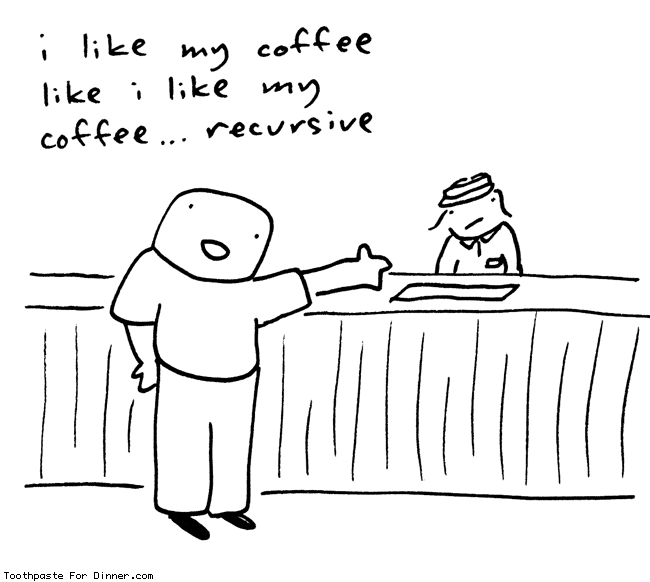
The beginning of wisdom is this: Get wisdom,Is that enough tautology for you? Getting wisdom is the beginning of wisdom. That's like saying the first step to cooking spaghetti is to cook the spaghetti.
and whatever else you get, get insight.
(4.7)
 |
| Thanks, Toothpaste for Dinner! |
 |
| Thanks, XKCD! |


