Grad school is wicked time consuming! This blog is currently on hold as the semester grinds on!

Showing posts with label Job. Show all posts

Tuesday, July 19, 2011

Ezekiel 1-12: On the move

I have written much of the dialectical tension that shape the biblical narrative, the push and pull between the word of God and the will of humankind. Intertwined with this plot-forming device is the device of movement. Throughout much of Israel's history, it has moved toward and away from the promised land. Now, long after conquering the promised land, Israel finds itself again out of God's favor and out their proper space.

At this point in the biblical narrative, it seems that God's people are permanently removed from the promised land. After they are given the land of Canaan, they fail to fulfill their contract and are expelled. In popular parlance, they blew it. (But that's human nature, as the bible widely attests.) The Babylonian exile represents the first time that Israel feels the bitter pull toward the land they possessed for so long.

The literature that developed during the time preceding and following the expulsion deals with the sense of loss in different ways. The Book of Job teaches how to deal with injustice. Lamentations mourns present conditions and looks to God for a panacea. Psalms offers myriad interpretations of punishment and reward. Prophets, like Jeremiah and Isaiah (First, Second, and Third), bring to light improper worship practices and preach social justice, while they deliver both predictions of terror and prophecies of salvation.

Ezekiel responds to the plight of the exile, and as a part of this offers the reassuring image of God in motion. Judah, home of God's people and God's residence on earth, is destroyed by the Babylonians in 587 BCE. Therefore in his tenure as a prophet from 593 to 571 BCE, Ezekiel can be seen as comforting the exiles from the deportations from Jerusalem. Part of this comfort comes from Ezekiel's particular vision of God as a mobile deity.

God in Motion
The Book of Ezekiel opens with Ezekiel's vision of God's chariot, but before turning to that, it is important to note the setting. Ezekiel receives his vision "in the land of the Chaldeans by the river Chebar; and the hand of the Lord was on him there." (Ezekiel 1.3)

Jeremiah is the first prophet we encounter that prophesies redemption explicitely  from captivity, delivering a distinct message to his audience. Jeremiah was in Israel for his entire tenure, Isaiah 1 and 3 prophesied from Israel, and Isaiah 2 consists of God's direct message to Israel (without the explicit medium of a prophet).

God's Chariot
Ezekiel's vision of God's chariot takes place in 593 BCE, five years after the first exile, and still six before the second in 587.
 
I recommend reading the entire vision sequence of Ezekiel 1-3.11 to get the full effect of the literature. For those of you who would rather not, here is an artist's rendition, courtesy of Wikipedia:
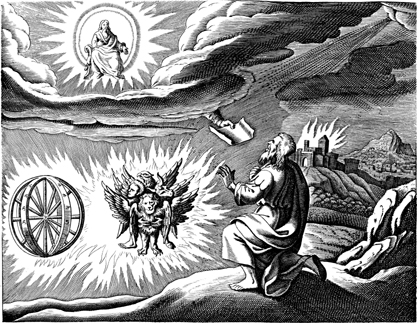

A stormy wind from the north (the direction of Babylon) blows in a phantasm that can only be described using the noncommittal mystical terms such as like and as. The four living creatures of the vision have legs and arms for mobility, and for whatever reason only move directly straight, without turning. Never mind exactly why, as Ezekiel is trying to put into words an ineffable mystical experience. (A description of mystical experience is not part-for-part allegory, by the way, but a "translation" of a mystical encounter).

That being said, we may focus on the prominent images of movement throughout the vision to guess at what exactly Ezekiel is trying to say. Ezekiel writes of his encounter:
"As I looked at the living creatures, I saw a wheel on the earth beside the living creatures, one for each of the four of them."
(Ezekiel 1.15)
One wheel or four? Both? In a vision, it doesn't really matter. The image is that of a wheel, which might signify completeness or more likely movement.
As for the appearance of the wheels and their construction: their appearance was like the gleaming of beryl; and the four had the same form, their construction being something like a wheel within a wheel. When they moved, they moved in any of the four directions without veering as they moved. Their rims were tall and awesome, for the rims of all four were full of eyes all around. When the living creatures moved, the wheels moved beside them; and when the living creatures rose from the earth, the wheels rose. Wherever the spirit would go, they went, and the wheels rose along with them; for the spirit of the living creatures was in the wheels. When they moved, the others moved; when they stopped, the others stopped; and when they rose from the earth, the wheels rose along with them; for the spirit of the living creatures was in the wheels.
(Ezekiel 1.16-21)
These wheels are capable of special locomotion, made possible by a wheel within a wheel. Four sets of tall and awesome double wheels propel the cart/chariot wherever it goes, forward and backward, up and down. The device is free to move in any direction in three dimensions. Additionally, the wheels function as a symbol of divine attentiveness. Eyes adorn all four wheels, indicating God's ubiquitous knowledge and presence. God is not only mobile, but all-seeing as well.

Ezekiel's Second Vision: Transportation
After this encounter, Ezekiel heads to Tel-abib, to reveal God's message to the exiles there. Here again Ezekiel encounters God. A year later in Judah (592 BCE), Ezekiel encounters God in a vision:
...and the spirit lifted me up between earth and heaven, and brought me in visions of God to Jerusalem, to the entrance of the gateway of the inner court that faces north...
(Ezekiel 8.3)
The vision is very similar, a fact that is even made explicit:
And the glory of the God of Israel was there, like the vision that I had seen in the valley.
(Ezekiel 8.4)
Again, Ezekiel faces north, the direction from which the Babylonians attack. He is then transported to various parts of the city, where he encounters the abominations that still occur in Jerusalem. Ezekiel is warned of the future hardships before being brought back.

This section is notable because again God has a remarkable range of motion. He is not limited to the Jerusalem temple, but can observe and even interact with his people in captivity.

Again we see the details of movement in his encounter:
I looked, and there were four wheels beside the cherubim, one beside each cherub; and the appearance of the wheels was like gleaming beryl. And as for their appearance, the four looked alike, something like a wheel within a wheel. When they moved, they moved in any of the four directions without veering as they moved; but in whatever direction the front wheel faced, the others followed without veering as they moved. Their entire body, their rims, their spokes, their wings, and the wheels—the wheels of the four of them—were full of eyes all around. As for the wheels, they were called in my hearing “the wheelwork.” Each one had four faces: the first face was that of the cherub, the second face was that of a human being, the third that of a lion, and the fourth that of an eagle. The cherubim rose up. These were the living creatures that I saw by the river Chebar. When the cherubim moved, the wheels moved beside them; and when the cherubim lifted up their wings to rise up from the earth, the wheels at their side did not veer. When they stopped, the others stopped, and when they rose up, the others rose up with them; for the spirit of the living creatures was in them.
(Ezekiel 10.9-17)
God's capability of movement is a remarkable development, and has a great influence on prophets and God's people, as we shall see in future chapters and later books.

Tuesday, April 5, 2011

Job: God and the Modern Reader

My spiel for blogging the bible thus far has been "dialectical tensions," the disconnect that exists between God's will and human action. In this model, humans are punished when they stray from God and rewarded when they are faithful. The book of Job challenges dialectical tensions with the tale of a pious man who is punished - without justification that we can understand in human terms.

Job is a work of "Wisdom Literature," which refers to three books of the Hebrew Scriptures: Job, Proverbs, and Ecclesiastes. This poetic, ideologic literature uses as a source similar wisdom literature of the ancient Near East, such as works from Egypt and Sumeria. We find parallels to Job in texts such as "The Babylonian Theodicy," and the anachronistically-named "Sumerian Job." These text deal with heavy issues that we still grapple with today, such as, What is the cause of suffering? Why is there evil in the universe? Why do good things happen to good people?

In The Bible as Literature, John B. Gabel et al. conclude, "It is clear, then, that wisdom writing in the Bible incorporates a tradition much older than its actual date of composition and that just like biblical narrational, legal, poetic, and historical writing, it can best be appreciated when seen in the broader context of the Ancient Near East" (57).

Gabel notes that for those reading the bible cover-to-cover, wisdom literature represents a departure from the norm. The book of Job does not drive the narrative forward. Thus far every book of the bible has either specified events that move the Israelites forward, or explained the origin of something within a specific context (such as Esther). Job instead is a philosophical text, one meant to explain why something is the way it is. The time period of the tale does not matter at all. However, it is worth noting that the text was composed during the exile, and deals at least tangentially with the fear that suffering is caused to people that don't seem to deserve it. The dialectical tension model is actively being called into question in the tale of Job. In fact, the book can be seen as making an alternative explanation for suffering and exile. And as we will see, to the modern day reader, the text leaves us with an uneasy feeling about God and his justice.

The Tale of Job
Job is a man living in the days between Noah and Abraham, and like these men he "was blameless and upright, one who feared God and turned away from evil." (Job 1.1) God considers Job his faithful "servant,"and essentially makes a bet with an angel called "the satan" that the eternally-faithful Job will not turn away from God even if he loses everything. In quick succession, Job loses his children, livestock, and servants. Yet he still remains faithful to God.

God is pleased at this, and the satan (meaning "adversary") challenges God that Job will not maintain his faith if his health is taken away. God again takes the bet, and Job becomes leprous. Job does not curse God, but he is rather perplexed.

What follows is many verses of argumentation between Job and three friends or "comforters." These men tell Job that people are punished because they are sinful, Job maintains that he is not sinful, and the friends contend that nobody on earth is without sin. (We can probably believe Job, though, that he is without blame in God's eyes.)

A fourth man rebukes Job, followed by God, who delivers a coup de gras rebuke. Job repents in words for questioning (though he never turned in his heart form God), he is rewarded twofold, and the story ends happily.

The above is a brief explanation, which I urge you to read on your own time. The book is a beautiful and poetic work - in fact, the majority is poetry. A quick framework of the narration is given below:
  • Job's goodness and punishment 1.1-2.10
  • Argumentation between Job and the four men 2.11-37
  • God's response 38-40.2
  • Job's response 40.3-5
  • God's challenge to Job 40.6-41
  • Job humbled 42.1-6
  • Job's friends rebuked 42.7-9
  • Job's fortunes restored 42.10-17
    Note that most of this book is argument about the nature of God. The true nature of god is explained by the deity himself in a few chapters, and Job's repentance, which makes up for his entire complaint, takes a mere six verses.

    Humble Job
    Job's full answer to the Lord reads thus:
    I know that you can do all things,
    and that no purpose of yours can be thwarted.

    "Who is this that hides counsel without knowledge?"

    Therefore I have uttered what I did not understand,
    things too wonderful for me, which I did not know.

    "Hear, and I will speak;
    I will question you, and you declare to me."

    I had heard of you by the hearing of the ear,
    but now my eye sees you;

    therefore I despise myself,
    and repent in dust and ashes.
    (Job 42.2-6)
    God is fully convinced of Job's devotion at this point, despite the time Job spent complaining of God's injustice. Perhaps Job's word is good; he was portrayed as a just man before, and the only incorrect move he makes is to question God; he does not commit apostasy. Job only argues that there is no correlation between the good one does and God's rewarding of these actions in this lifetime.

    The quick scene of Job's humbling is followed closely by a similarly short passage in which Job's "comforters" are "humiliated." God speaks to Job's three friends:
    My wrath is kindled against you [Eliphaz] and against your two friends [Bildad and Zophar], for you have not spoken of me what is right, as my servant Job has." (Job 42.7)
    Job speaks right not in his complaint, but in his submission to God. And indeed, the arguments of Job's "comforters" miss the mark just as much as Job's. Even as the main maintained his innocence, his friends asserted again and again that no one on earth could be innocent. God's argument responds to the friends as well as Job:

    Enough with the quibbling! There is no way you can understand me! And to misunderstand me is not only incorrect, but merits punishment.

    These men do not have an arm like God, and their voice does not thunder like his. (Job 40.9) The point should not be guilt or innocence. The true message that God wishes to extend to Job is that God should not, indeed cannot be questioned because God is on an entirely different level.

    Accepting God
    This is not an acceptable answer for someone that reads the bible as a piece of literature. What God says is ineffability is acually a bit of clever staging: some dramatic irony. This irony is set up at the beginning of the story when God tests Job by proxy of the satan simply to see whether Job will remain faithful. The modern reader that reads the book as a piece of literature should easily recognize this fallacy. God's excuse does not hold up; the narrator gave us his reason!

    The tale of Job, then, still leaves an existential aftertaste (a bitter taste, as I imagine it). Job seems to exist at the will of a capricious God, a petty God, even. The Lord does not provide a straight answer to Job. Instead, the deity unloads verse after verse of rebuke, while his true intention remains unknown to the seeker. It is a grand dramatic irony, and empathy on the part of the reader is understandable. The book of Job does not really comfort, not really answer the question of the will of God. Despite the happy ending of Job's fortunes being restored twofold, the story ends on an uneasy note. It ended well for Joseph, but God has revealed his capricious nature. The reader has glimpsed God, and been left with an unsettling afterimage of his presence.

    What are your thoughts on Job? Let me know in the comments below!