A blog of the bible reading from Genesis to Revelation that analyzes the text as a piece of literature written in history by living people separated by time, language, and geography.
Hosea prophesied in the Northern Kingdom of Israel during the reign of King Jeroboam II (ca. 786-746 BCE), after whose death the kingdom begins to decline before its defeat by the Assyrians in 722 BCE. According to the preface in the Harper Collins Study Bible, its core message can be gleaned in a declaration toward the end of the book, a restatement of the first commandment: "I have been the Lord your god ever since the land of Egypt; you know no God but me, and besides me there is no savior." (Hosea 13.4). The text vacillates between Israel's sin and salvation.
Unlike the prophets of the exile period [who we have recently read], Hosea does not deride Israel's enemies. Hosea is a prophet who seeks to reform Israel from the inside, so that it is a more just society. As the community is not in exile, the focus is entirely on the reform of the nation.
Hosea and Ezekiel
We can see interesting parallels between the prophets Hosea and Ezekiel, two of the great prophets of the Jewish people. Hosea is from the north, and anticipates Israel's demise. Ezekiel, who appears years later and witnessed the fall of Judah, is concerned mainly with the southern kingdom. However, their function as sign reveals an interesting typology. Like Hosea, Ezekiel acts as a sign to God's people through his relationship with his wife.
In Ezekiel's case, the prophet's wife dies and Ezekiel is forbidden from mourning, in anticipation of the coming exile, which will happen so quickly that it will not be mourned. In this sign, Ezekiel represents the Israelites and his wife represents Israel.
Hosea, on the other hand, is instructed to marry an unfaithful woman:
When the Lord first spoke through Hosea, the Lord said to Hosea, "Go, take for yourself a wife of whoredom and have children of whoredom, for the land commits great whoredom by forsaking the Lord."
The sign here is Gomer's (his wife's) promiscuity with men, which reflects Israel's insatiable turning to other gods and fertility cults. In this sign, Gomer represents Israel, and the jealous husband Hosea represents God.
God is not angry with the false gods that the Israelites pray to, but rather the Israelites themselves, who have turned away from him after establishing a binding covenant not unlike marriage. Though an exclusive contractual agreement, this is not the western marriage of equality that we enjoy today, but one in which the female party is explicitly the property of the male. To imagine Hosea's distress and anger is to imagine (though clearly not to understand) God's reaction toward his people Israel.
A rose by any other name
Hosea's children all have symbolic names, which point to important parts of Hosea's prophecy.
The current order is hopelessly corrupt, and can only be saved by radical change. This is made apparent in the naming of Hosea's only legitimate child, Jezreel, is named after the plane where Jehu slaughtered the house of Ahab. The implication is that the same fate that Jehu brought upon the old order (which itself was rife with apostasy) will be dealt to the current monarchy, which has decayed through its own apostasy. The preceding dynasty of Ahab was no better than the current on. The prophet that anoints Jehu king of Israel tells him,
"Thus says the Lord the God of Israel...You shall strike down the house of your master Ahab, so that I may avenge on Jezebel the blood of my servants the prophets, and the blood of all the servants of the Lord. For the Whole house of Ahab shall perish; I will cut off from Ahab every male, bond or free, in Israel."
(2 Kings 9.6-8)
But whereas in the past the Lord was content with simply wiping out the old order, presently a more radical change is needed. Israel will be harshly punished for its actions, and kings will never again reign in Israel or Judah.
Hosea's other two children are illegitimate, the product of Gomer's whoring. They serve as symbols of God's opinion of his people: Lo-ruhamah ("not pitied") and Lo-ammi ("I am not yours"). The signs stand for themselves.
Hosea's See-Saw
It is remarkable how quickly messages of rejection turn to messages of acceptance in Hosea. No sooner does God give the name for these children, than the tone completely shifts to one of deliverance. The effect is almost dizzying:
...Then the Lord said, "Name him Lo-ammi, for you are not my people and I am not your God." yet the number of the people of Israel shall be like the sand of the sea, [in fulfillment of the Genesis covenant] which can be neither measured nor numbered; and in the place where it was said to them, "You are not my people," it shall be said to them, "Children of the living God."
Remarkably, the image of Jezreel is upended here into a positive symbol, a common theme throughout Hosea. Frequently throughout its fourteen chapters we find that negative images are later expressed in a positive light:
"...and they shall take possession of the land, for great shall be the day of Jezreel."
(Hosea 1.11)
In this new world order, the Lord addresses the two children with their names minus the negative "Lo": Ammi and Ruhamah, meaning "my people" and "pitied." But as soon as their new names are uttered, the mother is rejected, and Israel's wrongdoing is again revealed.
Reaping and Sowing
An unfaithful wife is not the only image used to express Israel's unfaithfulness toward God. Images of agriculture are also used. Some are negative, and others positive, so that the positive images correct the negative:
For they sow the wind,
and they shall reap the whirlwind
(Hosea 8.7)
Sow for yourselves righteousness;
reap steadfast love;
break up your fallow ground;
(Hosea 10.12)
You have plowed wickedness,
you have reaped injustice,
you have eaten the fruit of lies.
(Hosea 10.13)
The text ends on a positive note, a plea for repentance followed by an assurance of forgiveness:
I will heal their disloyalty;
I will love them freely,
for my anger has turned from them.
(Hosea 14.4)
O Ephraim, what have I to do with idols?
It is I who answer and look after you.
I am like an evergreen cypress;
your faithfulness comes from me.
Those who are wise understand these things;
those who are discerning know them.
For the ways of the Lord are right,
and the upright walk in them,
but transgressors stumble in them.
(Hosea 14.8-9)
I must admit, I had trouble getting into this section of Ezekiel. Most of it is comprised of a blueprint for a new temple in Jerusalem and rules for governing the re-formed state. In the first couple readings it seemed like the same old rules an regulations that made Deuteronomy and Numbers and Leviticus just drag on.
But then I considered what Ezekiel was actually saying to us. What we have here is a radical message of hope. Those in exile receive the good news that Israel will be reestablished as a whole nation, along with a blueprint for how this all will be accomplished. This is the new temple and city as God wants it to be, when the time comes to reestablish it.
I began to see Ezekiel's vision of a tour through the temple not simply as instructions for the building of the temple and the governance of society, but also as a firsthand experience of the divine. This is a truly prophetic experience, in which Ezekiel is able to see the future Temple as God himself has designed it. And the prophet himself will be the intermediary that delivers the temple design to the people.
Vision of a New Temple
Ezekiel is transported in a vision to Mount Zion, the very location of the destroyed temple. There, he is given a tour of the new temple by a man, "whose appearance shone like bronze, with a linen cord and a measuring reed in his hand." (Ezekiel 40.3) The man takes Ezekiel on a tour of the Temple, in which he measures the entire property with the measuring reed. Ezekiel records the distances as they are marked.
The account takes us on a journey from the outside inward. We start at the 10-foot wall surrounding the temple and move inward to the most holy place, the "inner room." "This is the holy place," the man informs Ezekiel. (Ezekiel 41.4) Clearly this place is of great importance - it is here that the man speaks to the prophet for the first time since they began their tour. Indeed, the room is so holy that Ezekiel does not even enter it.
Having been brought slowly into the heart of the temple, we are then gradually led outside, to the outer wall of the temple, the boundary that separates sacred from profane.
Ezekiel is led to the east gate, and then is transported in a vision-within-a-vision back to the temple. Here he encounters the Lord's voice, and receives instructions about how to use and interpret the vision:
He said to me: Mortal, this is the place of my throne and the place for the soles of my feet where I will reside among the people of Israel forever. The house of Israel shall no more defile my holy name, neither they nor their kings, by their whoring, and by the corpses of their king at their death. When they placed their threshold by my threshold and their doorposts beside my doorposts, with only a wall between me and them, they were defiling my holy name by their abominations that they committed; therefore I have consumed them in my anger. Now let them put away their idolatry and the corpses of their kings far from me, and I will reside among them forever.
As for you, mortal, describe the temple to the house of Israel, and let them measure the pattern; and let them be ashamed of their iniquities. When they are ashamed of all that they have done, make known to them the plan of the temple, its arrangement, its exits and its entrances, and its whole form - all its ordinances and its entire plan and all its law; and write it down in their sight, so that they may observe and follow the entire plan and all its ordinances. This is the law of the temple: the whole territory on the top of the mountain all around shall be most holy. This is the law of the temple.
(Ezekiel 43.7-12)
Thus the temple is to be reestablished as a completely holy place, free of all the defilement of previous generations. Ezekiel brings this message of hope back to the exiles, the promise of Israel's reestablishment.
Signs of the Times
Ezekiel 24, which concludes a long section of visions and oracles against Jerusalem, terminates with two signs, both of which anticipate later events. Both of these signs consist of a symbolic act suggestive of the destruction of Jerusalem and its temple, followed by the event itself.
The first sign is the death of Ezekiel's wife, which the prophet is prohibited from mourning. Accomplished by God, this vignette serves as a metaphor for the impending fall of Jerusalem.
Say to the house of Israel, Thus says the Lord God: I will profane my sanctuary, the pride of your power, the delight of your eyes, and your heart's desire; and your sons and your daughters who you left behind shall fall by the sword. And you shall do as I have done; you shall not cover your upper lip or eat the bread of mourners. Your turbans shall be on your heads and your sandals on your feet; you shall not mourn or weep, but you shall pine away in your iniquities and groan to one another. Thus Ezekiel shall be a sign to you; you shall do just as he has done. When this comes, then you shall know that I am the Lord God.
(Ezekiel 24.21-24)
The sudden destruction of the temple will comes as a hard blow, yet will not be lamented, a circumstance that has both ritual and psychological implications. As a site of ritual, the temple served as the very center of daily life, and united the community under one God. Its destruction shatters the hope of proper worship practice that has already fragmented under apostasy and the deportations of the elite and priests. Without the temple and diligent obedience of the covenant, mourning practices lose much of their meaning. Forbidding orthopraxy simply serves to reinforce the peoples' distance from God.
The second sign of chapter 24 will not be fulfilled until 33.21-22, with the actual fall of Jerusalem. It is forecast that on the day that God conquers Jerusalem through his proxy Babylonian army, one person will escape the destruction to report the news to Ezekiel. On that day, the prophet's mouth will be opened and he will report the news to the exiles. In this way he will serve as a sign to the people that the word of the Lord will be accomplished.
Since chapters 25 through 32 consist entirely of oracles against and laments over foreign nations, let's skip over to chapter 33, which picks up again on God's addresses to Israel.
What do you mean, "You People?"
God's language in Ezekiel serves to distance himself from the prophet as well as his own people Israel. Ezekiel's moniker throughout the Book is "mortal" and the exiles are referred to as "your people." Ezekiel therefore acts as sort of a probation officer of sorts, the intermediary between the Law and the people. Ezekiel clearly serves as the spiritual leader on earth. In 33.1-9 he is named the sentinel of the Lord's people, a position of great responsibility. If he warns people of the bad things to come and they take no heed, he is blameless. If he fails to warn them, however, their blood is on his head. But even the Lord acknowledges that getting people to actually listen is futile - and the Lord has plenty of experience in this area.
To them you are like a singer of love songs, one who has a beautiful voice and plays well on an instrument; they hear what you say, but they will not do it.
(Ezekiel 33.32)
Which begs the questions: How many will ever believe a prophet in his/her own time?
Leader though he is, Ezekiel still answers to a higher authority. This is made clear through a number of images and instructions, the most prominent of which is God as the true shepherd, explicated in Ezekiel 34.The false shepherds of God's people are excoriated and God places himself as the true shepherd of all his flock. Though the Davidic line will be reestablished, the ruler of the Israelites will serve in a new capacity, with a greater emphasis on God. This idea is discussed further in Ezekiel 37, when the prophet executes a sign that Judah and Israelite will one day be united in one place under one Davidic ruler, and that all will be under God's jurisdiction.
Ezekiel 36 elucidates God's sovereignty, and sees a time when Israel will be restored:
Thus says the Lord God: On the day that I cleanse you from all your iniquities, I will cause the towns to be inhabited, and the waste places shall be rebuilt....Then the nations that are left all around you shall know that I, the Lord, have rebuilt the ruined places, and replanted that which was desolate; I, the Lord, have spoken, and I will do it.
(Ezekiel 36.33; 36)
But God also is sure to emphasize the role of his people within the renewed city. God's people their proper place within creation:
It is not for your sake, O house of Israel, that I am about to act, but for the sake of my holy name, which you have profaned among the nations to which you came. I will sanctify my great name...
(Ezekiel 36.22-23)
It is not for your sake that I will act, says the Lord God; let that be known to you. Be ashamed and dismayed for your ways, O house of Israel.
(Ezekiel 36.32)
And now, remarkably, there is a change in the nature of God's blessing. To the patriarchs, God promised to create a great nation of their offspring. After all the Israelites have done, they must now ask for what they were once given:
Thus says the Lord God: I will also let the hose of Israel ask me to do this for them: to increase their population like a flock.
(Ezekiel 36.37)
The Valley of Dry Bones and the Two Sticks
The renewal of the city is imagined as the reanimation of the dead in Ezekiel 37, an apt image for a conquered territory. In a vision, Ezekiel commands the divine spirit to animate the bones of the slain that rest in a valley. The bones come back together, attached by sinews and covered in skin. The message: through the help of the Lord, even a seemingly helpless situation can be rectified.
Both Israel and Judah will come together then under one king and Under God, and a new covenant will be established.
Gog and Magog
Anyone who has read the Book of Revelation or will be familiar with Gog and Magog, and it is from Ezekiel 38-39 that they are drawn from. Gog is a fictional ruler over the fictional land of Magog, and together they symbolize Israel's oppressors. After Israel is reestablished, it is said, Magog will attack Israel with the support of many other nations, and will be soundly defeated. In this way, Israel symbolically will pay back the pain that other nations have caused it.
The images of destruction seem to serve a cathartic purpose. Led by the lord to Israel, Gog and his supporting armies will be defeated, and their weapons shall be burned by the Israelites as firewood. Israel's victory will be so great that all of Israel will spend seven months burying the dead in order to purify the land. And, as all the residents of the kingdom take part, it serves as a cleansing action for the community as well.
The deaths of Israel's enemies is even imagined in terms of a sacrificial feast - though for the birds and wild animals of the land. The slaughter holds a ritualistic connotation, one that is nevertheless very far removed from the Israelite idea of sacrifice. The fat and blood that the Israelites do not eat in their sacrifices is instead devoted to the animals and birds, who fulfill for Israel another sacrificial feast, another cleansing of the land.
Ezekiel 25-32 consists of oracles against and laments over foreign nations, a sort of reassurance of Israel after God thoroughly censures his people. Though Israel is in the process of being brought down, it will one day be raised back up, and its neigboring countries will suffer a harsh fate for their conduct against Israel, whether it was warfare, mockery, or failing to protect God's people.
The following nations are singled out: Ammon, Moab, Edom, Philistia, Tyre, Sidon, and Egypt.
Ammon
Ammon will be handed over to the nomads of the east, who will set up shop in the area: "They shall set their encampments among you and pitch their tents in your midst; they shall eat your fruit, and they shall drink your milk. This is retribution for their rejoicing at the destruction of Israel. It is said that Ammon will be wiped from history.
Moab
Moab will suffer the same fate because they never recognized Israel's prominent status with God.
Edom
Edom will have the Lord's vengeance thrust upon it for its past vengeance upon Israel.
Philistia
The hostility of the Philistines against Israel will be repaid with the wrathful punishment of God.
Tyre
The section of oracles against Tyre is broken up into four parts, a proclamation against the land, a lament over the land, a proclamation against the king, and a lament over the king. Tyre is built up to be a great land with a ruler that is described in primordial terms and even at one point seems to have had God's support. Tyre's special treatment probably stems from the fact that it was able to repel the Babylonians for 13 years, and escaped from the encounter intact. Judah, on the other hand, was unable to stand against the strong hand of Nebuchadnezzar.
Proclamation against Tyre: Ezekiel 26
God's wrath falls on Tyre because it rejoices at Israel's destruction, knowing that this will increase its commerce. The Lord will bring the armies of many nations onto Tyre, and it will be completely destroyed:
I will make you a bare rock;
you shall be a place for spreading nets.
(Ezekiel 26.14)
Lamentation over Tyre: Ezekiel 27
The Lamentation over Tyre takes the form of prose and poetry listing all the nations that the city-state had contact with and benefited from.
Maritime imagery dominates the first poetic section, fitting as the port city served as a an important commercial center. Tyre is first described as a ship, with planks from the firs of Senir, a mast made of the cedar of Lebanon, oars from the oaks of Bashan, a deck made of pines from Cyprus, a linen sail from Egypt, awning from Elishah, rowers from Sidon and Arvad, and pilots from Zemer. The elders and artisans of Gebal caulk the seams.
The poem then turns to militaristic imagery: an army that featured men from Paras, Lud, Put, Arvad, Helech, Gamad.
It continues with descriptions of all the other nations that used Tyre's ports: Tarshish, Javan, Tubal, Meshech, Beth-Togarmah, the Rhodians, Edom, Judah and Israel, Damascus, Helbon, Vedan and Javan from Uzal, Dedan, Arabia and all the princes of Keday, Sheba and Raamah, Haran, Canneh, Eden, Sheba, Asshur, Chilmad.
These countries and their wares listed, the poem reverts to sea imagery in order to show the destruction of the ship. Tyre goes down with all its wares and most of the nations that support it. A great lament will be raised for the destruction of so great a people.
Proclamation against the King of Tyre: Ezekiel 28.1-10
The King of Tyre is a very wise man, but he is also very bold. Though God confesses the man is wiser than even the wise mythical king Daniel, he also promises to strike the King down for self-deification. Both he and his kingdom will be destroyed by foreign armies.
Lamentation over the King of Tyre: Ezekiel 28.11-19
The King of Tyre is further extolled in the beginning of the lamentation over him, for the purpose of bringing him very low at the end.
You were the signet of perfection,
full of wisdom and perfect in beauty.
You were in Eden, the garden of God;
every precious stone was your covering...
With an anointed cherub as guardian I placed you;
you were on the holy mountain of God;
you walked among the stones of fire.
You were blameles in your ways
from the day that you were created,
until iniquity was found in you.
(Ezekiel 28.12-13; 14-15)
The King of Tyre enjoys a mythical back story that features elements of the Genesis tale of cosmogony. He was in Eden, on the very mountain of God (the description posits Zion as the location of the Edenic narrative). Blameless, he walks in a paradise created by God, protected by one of God's own cherubim. This man is not even related to Jacob!
But even he is cast down when the Lord discovers the evil within him. And for his violence and iniquities he is exposed and conquered.
Sidon
For treating Israel with contempt, Sidon will be besieged with both war and pestilence.
Egypt
Of all the countries listed, Egypt receives the harshest treatment from the Lord, with a total of seven pronouncements against it. Like Tyre, Egypt also resisted Babylonian invasion. However, Egypt deserves even greater retribution in God's eyes because it was unable to protect Israel from the Babylonians.
...because you were a staff of reed
to the house of Israel;
when they grasped you with the hand, you broke,
and tore all their shoulders;
and when they leaned on you, you broke,
and made all their legs unsteady.
(Ezekiel 29.6-7)
For this, and for her pride, Egypt will be brought low:
I will make the land of Egypt a desolation among desolated countries; and her cities shall be a desolation forty years among cities that are laid waste. I will scatter the Egyptians among the nations, and disperse them among the countries.
(Ezekiel 29.12)
Generally, nations that receive God's retribution are completely destroyed. This is not the case for Egypt, however, whose people are dispersed. There is a certain resonance with the plight of the Israelites here. Both nations are conquered and their people dispersed for a long period of time (the forty years is not literal, but a symbolic number indicating a long period of time that is brought to completion). In fact, they will be conquered - at least it is predicted - by the Babylonians, adding a further kindred resonance. The destruction is described in violent detail in Ezekiel 32.
In continuing this idea, Egypt will again be restored, albeit to a much lesser degree. The purpose of this seems to be humiliation. Even worse than eradication, Egypt will fail as an ineffectual state as Israel becomes a great nation. Egypt will be defined by its shortcomings, in contrast with Israel.
Last week we explored the prophet Ezekiel's mystical encounter with God. As I noted, description of mystical encounters are not to be taken as piece-for-piece parables or allegories. Rather, we may interpret certain images within them to arrive at a sense of what the encounter signifies.
Today we encounter a different form of revelatory experience: allegories or parables given directly from God to the prophet. These have a few different functions, such as the revelation of history through a riddle to trick the reader into accepting the Lord's propositions. Others indict directly. No matter how these stories are used, however, the symbolism is understandable and direct, corresponding to true historical events. Below are five examples of this sort of meaning making.
God's Faithless Bride
One of the most compelling accounts of Israel's shameful history comes in Ezekiel 16, titled in the New Revised Standard Version, "God's Faithless Bride." Here "the Lord God of Jerusalem" recounts the history in a highly stylized, metaphorical style.
Jerusalem was born "in the land of the Canaanites," (Ezekiel 16.3) phrasing that precludes ownership. Israel is a stranger here, the child of an Amorite father and Hittite mother. These, of course, were the people that preceded the Israelites in Canaan, the promised land.
Jerusalem is born an abandoned in an open field, receiving no birth rituals; her umbilical cord even remains uncut. No one pities the bloody flailing child but God, who happens upon her and commands her to, "Live! and grow up like a plant of the field." (Ezekiel 16.6-7) Jerusalem sprouts into full womanhood, though is still naked and bloody when God encounters her a second time:
I passed by you again and looked on you; you were at the age for love. I spread the edge of my cloak over you, and covered your nakedness: I pledged myself to you and entered into a covenant with you, says the Lord God, and you became mine.
(Ezekiel 16.8)
God washes the blood from Jerusalem's body and clothes her. He adorns her in fine clothing and jewelry, and gives her the finest food. Jerusalem becomes renowned for her beauty among the nations. Rising up from an ignoble beginning, Jerusalem is at its best.
Then things go awry. Jerusalem begins to whore herself to other me - that is, she turns to other gods. (This imagery is very common in biblical literature, and Ezekiel uses the unfaithful wife motif extensively.) Jerusalem even sacrifices her children - the most tangible sign of the covenant with her husband God - to the false gods.
In succession, Jerusalem is rebuked for whoring herself to the Egyptians, the Philistines, Assyria, and Chaldea (Babylon). The list parallels the troubled history of God's people: slavery in Egypt, conflict with Philistia, and a tumultuous relationship with Assyria and Babylon that alternated between submission and trade and armed conflict.
God notes that Israel's "whoring" is unique for its subversion of the sex-marriage economy. Generally prostitutes receive payment for their services. Jerusalem, however, renders services and makes payments to her clients. We can easily see why God would be angry with her behavior. Not only is his wife unfaithful, but she is giving to her lovers the very gifts that he gave to her.
For this God promises wrath. She will be delivered into the hands of her enemies - those who were once her lovers:
Because you have not remember the days of you youth, but have enraged me with all these things; therefore, I have returned your deeds upon your head, says the Lord God.
(Ezekiel 16.43)
While it might be easy to understand the need for retribution, the line that precedes this verse seems to speak with the voice of an abusive husband when read in a modern light:
So I will satisfy my fury on you, and my jealousy shall turn away from you; I will be calm, and will be angry no longer.
(Ezekiel 16.42)
God must expend all his anger before he will again accept his bride. This is not the portrait of domestic abuse popularized by Eminem - though one can see the parallels in a broken contract and a propensity to do harm.
This is on a completely different level, the breaking of a contract between God and an entire people. God offers the easy yoke to those that are faithful, but too many are reluctant to take that bear their faith entirely in God.
God returns in his excoriation to the image of family: Jerusalem as daughter of a Hittite and Amorite. The idea is expanded into a complete family of sinners. Samaria, the northern kingdom of Israel, is Jerusalem's elder sister, while the notoriously sinful city of Sodom is Jerusalem's younger sibling. Not even these cities are as sinful as Jerusalem, claims the Lord, though Sodom was destroyed long ago and Samaria has already been conquered. Indeed, the sisters will be restored even as Jerusalem languishes. Thus the city will feel shame for its sins.
In classical prophetic style, however, Jerusalem is promised salvation:
Yes, thus says the Lord God: I will deal with you as you have done, you who have despised the oath, breaking the covenant; yet I will remember my covenant with you in the days of your youth, and I will establish with you an everlasting covenant.
(Ezekiel 16.59-60)
Though it has been noted by others that negative prophecies are most frequently correct, this one does come true in part with the ascension of King Cyrus.
The Useless Vine
Ezekiel 15 offers a sophisticated riddle that is meant to reveal the truth about Jerusalem through a clever reveal. The riddle works by introducing a situation and convincing the reader of a truth about it, before revealing that actually the situation is representative of something that directly affects the reader. In this way, riddle solvers indict themselves. This particular riddle goes as follows:
O mortal, how does the wood of the vine surpass all other wood -
the vine branch that is among the trees of the forest?
Is wood taken from it to make anything?
Does one take a peg from it on which to hang any object?
(Ezekiel 15.2-3)
Well, no, the reader replies. People do not use vine wood for pegs. Vines do not surpass any wood at all - all they are good for is burning.
The vine, of course, is Jerusalem. Indeed, says the Lord, this useless city will be burned. It will be consumed and made desolate because it has not positive use for God. It does not give back to the Lord in any way, so why should he not destroy it to create the more useful fire?
The Two Eagles and the Vine
The next reference to the vine of Jerusalem (Ezekiel 17) is highly allegorical, a riddle whose question is phrased in poetry and answer revealed in prose.
A great eagle, representing the Babylonian king Nebuchadnezzar, removes the top of a Lebanon cedar, representing King Jehoiachin, and takes it away to a "city of merchants," representing exile. The eagle then takes a seed - the offspring of Jehoiachin, Zedekiah - who is initially loyal to the eagle and therefore prospers.
Soon another eagle appears, representing the pharaoh Psammetichus. The vine is drawn to its brilliant plumage and great wings, and its allegiance transfers. This is a fatal move, as Egypt is not able to protect Jerusalem against the angry Babylonian monarchy. There will be great struggle and destruction.
But eventually God will intervene, taking "a sprig from the lofty top of a cedar." (Ezekiel 17.22) It will be planted on the mountain height of Israel to proper. In fact, the sprig will grow to become the greatest of the nations: "Under it every kind of bird [certainly even great eagles!] will live; in the shade of its branches will nest winged creatures of every kind." (Ezekiel 17.23)
Not only will Israel be recognized, but God as well. All nations will finally bow before him:
All the trees of the field shall know
that I am the Lord.
I bring low the high tree,
I make high the low tree;
I dry up the green tree
and make the dry tree flourish.
I the Lord have spoken;
I will accomplish it.
(Ezekiel 17.24)
Judah the Lion
[Fun fact: Ariel means "Lion of God" in Hebrew]
Judah is frequently identified with a lion for Jacob's blessing of the tribal patriarch in Genesis:
Judah is a lion’s whelp; from the prey, my son, you have gone up. He crouches down, he stretches out like a lion, like a lioness—who dares rouse him up?
(Genesis 49.9)
Ezekiel picks up on this theme in chapter 19, a lamentation for fallen Judah, who was the great lioness. Here cubs were reared to be great lions, to catch prey and devour humans, but nations raise the alarm and capture them, afraid of the power that they wield. Here the lioness is the nation of Judah and the cubs it kings. Jehoahaz is deported to Egypt and both Jehoiachin and Zedekiah are exiled to Babylon. Though the lioness mother Judah attempts to raise strong offspring, here enemies are stronger than they.
The Vine Again
The lament abruptly transitions to an image of mother Judah as a vine of great mass and height in a vineyard. The vine is destroyed by various means: plucked up and cast down (armed conflict), dried by an eastern wind (siege warfare and famine), stripped of fruit (death, attrition), consumed by fire (conquered), and transplanted (exiled).
And the fire has gone out from its stem,
has consumed its branches and fruit,
so that there remains in it no strong stem,
no scepter for ruling.
(Ezekiel 19.14)
These verses have a remarkable resonance with Jacob's blessing of Judah in Genesis (mentioned above):
The scepter shall not depart from Judah, nor the ruler’s staff from between his feet, until tribute comes to him; and the obedience of the peoples is his. Binding his foal to the vine and his donkey’s colt to the choice vine, he washes his garments in wine and his robe in the blood of grapes; his eyes are darker than wine, and his teeth whiter than milk.
(Genesis 49.10-12)
Oholah and Oholibah
Finally we come to Ezekiel 23, another parable of Judah's sin and God's retribution. "Born" in Egypt, the sisters Oholah (Samaria) and Oholibah (Judah) both become brides of the Lord and bear children. For the time being, at least, God overlooks the fact that they are "damaged goods" - that in Egypt they have already been dealt with sexually.
Oholah soon whores herself to the Assyrians, and is killed - not by God - but clearly in retribution for her unfaithfulness. Oholibah also lusts after the Assyrians, but soon turns to the Babylonians, then Egypt. The last of these is portrayed as a return to an old lover:
Thus you longed for the lewdness of your youth, when the Egyptians fondled your bosom and caressed your breasts.
(Ezekiel 23.21)
Jerusalem, which has not yet suffered exile (the "death" of Oholah) is therefore warned of impending fury that God will unleash, dealt through the armies of the vary nations Oholibah once loved. She will suffer the same fate as her sister. Says the Lord:
For they have committed adultery, and blood is on their hands; with their idols the have committed adultery; and they have even offered up to them for food the children whom they had borne to me.
(Ezekiel 23.37)
Judah will indeed be punished. But the beauty of God's relationship with his people is that there is always room for reconciliation.
The Boiling Pot
One final allegory comes in Ezekiel 24, a boiling pot to cook an animal. The imagery is complex, but it seems that the pot is rusted on the inside, making worthless the food cooked within. Furthermore, the blood that Jerusalem has shed is symbolically inside the pot, an image that God uses to incriminate the city. The Lord will also take a rusted pot, symbolic of Jerusalem, and heat it, so that the filth and rust within it is consumed. In this way, the pot will be cleansed. But the cleansing of Jerusalem clearly will have dire consequences for its people.
Thus concludes today's post.
As for me, this reading really brought out the feminist in me. The language of the bible is remarkable here in its portrayal of women and violence. Could it have been put another way and understood as poignantly? What do you think? Let me know in the comments!
I have written much of the dialectical tension that shape the biblical narrative, the push and pull between the word of God and the will of humankind. Intertwined with this plot-forming device is the device of movement. Throughout much of Israel's history, it has moved toward and away from the promised land. Now, long after conquering the promised land, Israel finds itself again out of God's favor and out their proper space.
At this point in the biblical narrative, it seems that God's people are permanently removed from the promised land. After they are given the land of Canaan, they fail to fulfill their contract and are expelled. In popular parlance, they blew it. (But that's human nature, as the bible widely attests.) The Babylonian exile represents the first time that Israel feels the bitter pull toward the land they possessed for so long.
The literature that developed during the time preceding and following the expulsion deals with the sense of loss in different ways. The Book of Job teaches how to deal with injustice. Lamentations mourns present conditions and looks to God for a panacea. Psalms offers myriad interpretations of punishment and reward. Prophets, like Jeremiah and Isaiah (First, Second, and Third), bring to light improper worship practices and preach social justice, while they deliver both predictions of terror and prophecies of salvation.
Ezekiel responds to the plight of the exile, and as a part of this offers the reassuring image of God in motion. Judah, home of God's people and God's residence on earth, is destroyed by the Babylonians in 587 BCE. Therefore in his tenure as a prophet from 593 to 571 BCE, Ezekiel can be seen as comforting the exiles from the deportations from Jerusalem. Part of this comfort comes from Ezekiel's particular vision of God as a mobile deity.
God in Motion
The Book of Ezekiel opens with Ezekiel's vision of God's chariot, but before turning to that, it is important to note the setting. Ezekiel receives his vision "in the land of the Chaldeans by the river Chebar; and the hand of the Lord was on him there." (Ezekiel 1.3)
Jeremiah is the first prophet we encounter that prophesies redemption explicitely from captivity, delivering a distinct message to his audience. Jeremiah was in Israel for his entire tenure, Isaiah 1 and 3 prophesied from Israel, and Isaiah 2 consists of God's direct message to Israel (without the explicit medium of a prophet).
God's Chariot
Ezekiel's vision of God's chariot takes place in 593 BCE, five years after the first exile, and still six before the second in 587.
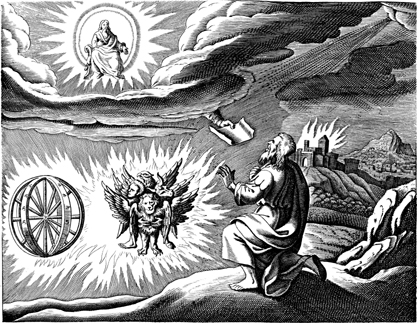
I recommend reading the entire vision sequence of Ezekiel 1-3.11 to get the full effect of the literature. For those of you who would rather not, here is an artist's rendition, courtesy of Wikipedia:
A stormy wind from the north (the direction of Babylon) blows in a phantasm that can only be described using the noncommittal mystical terms such as like and as. The four living creatures of the vision have legs and arms for mobility, and for whatever reason only move directly straight, without turning. Never mind exactly why, as Ezekiel is trying to put into words an ineffable mystical experience. (A description of mystical experience is not part-for-part allegory, by the way, but a "translation" of a mystical encounter).
That being said, we may focus on the prominent images of movement throughout the vision to guess at what exactly Ezekiel is trying to say. Ezekiel writes of his encounter:
"As I looked at the living creatures, I saw a wheel on the earth beside the living creatures, one for each of the four of them."
(Ezekiel 1.15)
One wheel or four? Both? In a vision, it doesn't really matter. The image is that of a wheel, which might signify completeness or more likely movement.
As for the appearance of the wheels and their construction: their appearance was like the gleaming of beryl; and the four had the same form, their construction being something like a wheel within a wheel. When they moved, they moved in any of the four directions without veering as they moved. Their rims were tall and awesome, for the rims of all four were full of eyes all around. When the living creatures moved, the wheels moved beside them; and when the living creatures rose from the earth, the wheels rose. Wherever the spirit would go, they went, and the wheels rose along with them; for the spirit of the living creatures was in the wheels. When they moved, the others moved; when they stopped, the others stopped; and when they rose from the earth, the wheels rose along with them; for the spirit of the living creatures was in the wheels.
(Ezekiel 1.16-21)
These wheels are capable of special locomotion, made possible by a wheel within a wheel. Four sets of tall and awesome double wheels propel the cart/chariot wherever it goes, forward and backward, up and down. The device is free to move in any direction in three dimensions. Additionally, the wheels function as a symbol of divine attentiveness. Eyes adorn all four wheels, indicating God's ubiquitous knowledge and presence. God is not only mobile, but all-seeing as well.
Ezekiel's Second Vision: Transportation
After this encounter, Ezekiel heads to Tel-abib, to reveal God's message to the exiles there. Here again Ezekiel encounters God. A year later in Judah (592 BCE), Ezekiel encounters God in a vision:
...and the spirit lifted me up between earth and heaven, and brought me in visions of God to Jerusalem, to the entrance of the gateway of the inner court that faces north...
(Ezekiel 8.3)
The vision is very similar, a fact that is even made explicit:
And the glory of the God of Israel was there, like the vision that I had seen in the valley.
(Ezekiel 8.4)
Again, Ezekiel faces north, the direction from which the Babylonians attack. He is then transported to various parts of the city, where he encounters the abominations that still occur in Jerusalem. Ezekiel is warned of the future hardships before being brought back.
This section is notable because again God has a remarkable range of motion. He is not limited to the Jerusalem temple, but can observe and even interact with his people in captivity.
Again we see the details of movement in his encounter:
I looked, and there were four wheels beside the cherubim, one beside each cherub; and the appearance of the wheels was like gleaming beryl. And as for their appearance, the four looked alike, something like a wheel within a wheel. When they moved, they moved in any of the four directions without veering as they moved; but in whatever direction the front wheel faced, the others followed without veering as they moved. Their entire body, their rims, their spokes, their wings, and the wheels—the wheels of the four of them—were full of eyes all around. As for the wheels, they were called in my hearing “the wheelwork.” Each one had four faces: the first face was that of the cherub, the second face was that of a human being, the third that of a lion, and the fourth that of an eagle. The cherubim rose up. These were the living creatures that I saw by the river Chebar. When the cherubim moved, the wheels moved beside them; and when the cherubim lifted up their wings to rise up from the earth, the wheels at their side did not veer. When they stopped, the others stopped, and when they rose up, the others rose up with them; for the spirit of the living creatures was in them.
(Ezekiel 10.9-17)
God's capability of movement is a remarkable development, and has a great influence on prophets and God's people, as we shall see in future chapters and later books.