Grad school is wicked time consuming! This blog is currently on hold as the semester grinds on!

Showing posts with label Laws. Show all posts

Tuesday, August 16, 2011

Ezekiel 40-48: A New Temple, a New Israel

I must admit, I had trouble getting into this section of Ezekiel. Most of it is comprised of a blueprint for a new temple in Jerusalem and rules for governing the re-formed state. In the first couple readings it seemed like the same old rules an regulations that made Deuteronomy and Numbers and Leviticus just drag on.

But then I considered what Ezekiel was actually saying to us. What we have here is a radical message of hope. Those in exile receive the good news that Israel will be reestablished as a whole nation, along with a blueprint for how this all will be accomplished. This is the new temple and city as God wants it to be, when the time comes to reestablish it.

I began to see Ezekiel's vision of a tour through the temple not simply as instructions for the building of the temple and the governance of society, but also as a firsthand experience of the divine. This is a truly prophetic experience, in which Ezekiel is able to see the future Temple as God himself has designed it. And the prophet himself will be the intermediary that delivers the temple design to the people.

Vision of a New Temple

Ezekiel is transported in a vision to Mount Zion, the very location of the destroyed temple. There, he is given a tour of the new temple by a man, "whose appearance shone like bronze, with a linen cord and a measuring reed in his hand." (Ezekiel 40.3) The man takes Ezekiel on a tour of the Temple, in which he measures the entire property with the measuring reed. Ezekiel records the distances as they are marked.

The account takes us on a journey from the outside inward. We start at the 10-foot wall surrounding the temple and move inward to the most holy place, the "inner room." "This is the holy place," the man informs Ezekiel. (Ezekiel 41.4) Clearly this place is of great importance - it is here that the man speaks to the prophet for the first time since they began their tour.  Indeed, the room is so holy that Ezekiel does not even enter it.

Having been brought slowly into the heart of the temple, we are then gradually led outside, to the outer wall of the temple, the boundary that separates sacred from profane.

Ezekiel is led to the east gate, and then is transported in a vision-within-a-vision back to the temple. Here he encounters the Lord's voice, and receives instructions about how to use and interpret the vision:
He said to me: Mortal, this is the place of my throne and the place for the soles of my feet where I will reside among the people of Israel forever. The house of Israel shall no more defile my holy name, neither they nor their kings, by their whoring, and by the corpses of their king at their death. When they placed their threshold by my threshold and their doorposts beside my doorposts, with only a wall between me and them, they were defiling my holy name by their abominations that they committed; therefore I have consumed them in my anger. Now let them put away their idolatry and the corpses of their kings far from me, and I will reside among them forever.

As for you, mortal, describe the temple to the house of Israel, and let them measure the pattern; and let them be ashamed of their iniquities. When they are ashamed of all that they have done, make known to them the plan of the temple, its arrangement, its exits and its entrances, and its whole form - all its ordinances and its entire plan and all its law; and write it down in their sight, so that they may observe and follow the entire plan and all its ordinances. This is the law of the temple: the whole territory on the top of the mountain all around shall be most holy. This is the law of the temple.
(Ezekiel 43.7-12)
Thus the temple is to be reestablished as a completely holy place, free of all the defilement of previous generations. Ezekiel brings this message of hope back to the exiles, the promise of Israel's reestablishment.

Tuesday, April 26, 2011

Psalms 3: Psalm 119 - God's Law

So far, this blog has focused on the relationship between God and humankind as one driven by dialectical tensions - the difference between God's will and human action. In last week's post, I argued that these are the result of the covenant between God and his people, the Israelites; if the people obey God, they are ensured his divine protection. But as the story of Job demonstrated, sometimes it is difficult for humans to perceive that God is upholding his end of the deal. This is the topic we will discuss today in analyzing Psalm 119. What happens when God does not seem to fulfill the terms of his covenant with humanity?

We have the  promise and law causing a dissonance within Psalm 119. Both of these derive from the covenant between God and humanity, and both have discreet functions. The promise is asked to be remembered by God - it is God's terms of the covenant. The law, on the other hand, is required of the psalmist by God. The psalmist must uphold God's law in order to remain in good standing in the contract.

Psalm 119 features eight synonyms that all represent God's law:
  • Law
  • Decrees
  • Way(s)
  • Statutes
  • Precepts
  • Commandments,
  • Ordinances
  • Word
Of these, the reader must be careful with "way" and "word", as these do not always connote God's divine law. "Law" is something that is followed, but "word" and "way" can also represent what God promises - namely, deliverance from enemies. To further complicate the matter, in Psalm 119, the phrasing for both facets of God's law and God's promises is the same. The facet is generally given as "your ___" (e.g. your law, your decrees). Law and promise seem to be indistinguishable. As we shall see, however, the psalmist means something very particular when he is referring to law and promise, respectively.

Let's turn to some poetry for an example:
Remember your word to your servant, / in which you have made me hope.
This is my comfort in my distress, / that your promise gives me life.
(Psalm 119 49-50)
This poetic technique is known as chiasmus, in which similar terms cross one another. If we were to draw one line between "hope" and "comfort," and another between "your word" and "your promise," the result would look like an X. Hence, chiasmus, coming from the Greek Letter Chi (X). "Your word" and "your promise" link up synonymously, as do the ideas of hope and comfort in distress. In this instance, word refers to God's covenantal promise.

In the following example, however, God's word is synonymous with law:
Before I was humbled, I went astray, / but now I keep your word.
You are good and do good. / Teach me your statutes
(Psalm 119 67-68)
Two things indicate the connection between word and law. One is the parallel linkage of word and statutes. The other is the phrasing in verse 67: "Now I keep your word." The psalmist is the one who obeys God's will, which is the prime example of law.

The human-divine relationship is elucidated in verses 145-149, in which the psalmist shifts from law to promise, and then back to law:
With my whole heart I cry; answer me, O Lord.
I will keep your statutes.
I cry to you; save me,
that I may observe your decrees.
I rise before dawn and cry for help;
I put my hope in your words.
My eyes are awake before each watch of the night,
that I may meditate on your promise.
In your steadfast love hear my voice;
O Lord, in your justice preserve my life.
(Psalm 119 145-149)
Note that statutes are kept and decrees are observed by the psalmist. On the other hand, it is words that the psalmist puts his hope in, and God's promise that he meditates on. Laws are followed, but God's promise is contemplated, the source of hope and faith.

Words and promise are further clarified by what might be considered a synonym: steadfast love. This is an explicit term of the covenant: God's steadfast love for his people - even when they disobey him. Perhaps they are not given protection during times of apostasy. However, the covenant still exists, and God's people experience his steadfast love.

Verses 153 and 154 are parallel, yet not synonymous. Here, the second verse builds on the first, forming something of a crescendo:
Look on my misery and rescue me,
for I do not forget your law.
Plead my cause and redeem me;
give me life according to your promise.
(Psalm 119 153-154)
In succession, the psalmist is seen and rescued, his cause pleased, and his life redeemed. Interestingly, the language is all judicial, and serves to express both God's law and his promise. The psalmist is seen and rescued because of his adherence to the Lord's law. His case is pleaded and his life is redeemed because the Lord fulfills his promise. In judicial language, both parties are shown upholding their respective terms of the contract.

What can we learn from the psalmist's relationship with God? We know that obedience of God's law will result in protection from enemies. However, the faithful will at times have to request God's protection, as made amply evident in the song. God will, however, always act eventually, just as he did in Job. Of course, this analysis of God's relationship with humans assumes that an individual's relationship with God is personal. What we might need to consider for further analysis is the relationship between God and God's people as a group. After all, the initial covenant with Noah promised protection for all humanity, and subsequent covenants afford land and fertility for the offspring of a patriarch. It would appear that in the time of Israel's offspring, God protects the group as a whole. By the time of David, the Israelites live or die based on the actions of one individual, the king. Therefore it might be difficult to conceive of a communal relationship vis-a-vis a personal one. After the exile, there is no leader, so the question of individual autonomy versus that of the group remains open...

Until next time.

Thursday, September 23, 2010

Deuteronomy 31: Confronting Moses' death

Deuteronomy 31: Joshua Becomes Moses' Successor / The Law to be Read Every Seventh Year / Moses and Joshua Receive God's Charge

Soon the 120-year-old Moses is to die. Before he does, there is some business to take care of.

Joshua Becomes Moses' Successor: Deuteronomy 31.1-8
Moses, if you recall, has been dictating God's law to Israel for the entire book of Deuteronomy. Here he finishes an old man - not old because he spoke so long, but because he is blessed by the Lord with a long life. Yet because of the iniquity of the people he will not enter the promised land. It is God that will lead the Israelites across the Jordan and God that will ensure the Israelites destroy the people living there, just as God did to Sihon and Og. Moses urges his audience to have no fear, because the Lord is with them and will not forsake them.

Moses the charges Joshua to be strong and bold, because he will lead the people into the Land. [Joshua will take the place of Moses as the mouthpiece of God to th Israelites.] The Lord is with him and will not forsake him.

The Law to be Read Every Seventh Year: Deuteronomy 31.9-13
Moses then writes down the law he dictated to the Israelites. he gives it to the Levites, who carry it to the ark of the covenant and the elders of Israel.

Moses commands that the book of the law should be read every seventh year at the festival of booths, when all of Israel appears before God in the place of consolidated worship.

[The reading of the law every seven years is an attempt to ensure that the commandments are all fresh in the minds of the Israelites, and obeyed. Of course, seven years is a long time...]

Moses and Joshua Receive God's Charge: Deuteronomy 31.14-29
The Lord tells Moses that Moses will soon die, and that Joshua should be brought to the tent of meeting, so that he may be commissioned [as Moses was]. The Lord appears at the tent in a pillar of cloud, the traditional representation of God throughout Israel's journey through the wilderness.

God tells Moses that after his death, the people will begin to fall away from God. They will eat their fill and grow fat and complacent. They will turn to other Gods. In that time, the Lord will turn away from the people. The Lord therefore gives Moses a song to teach the people, that will be passed down through the generations. When the people sing this song, they will remember their broken covenant with the Lord.

The Lord then commissions Joshua son of Nun: "Be strong and bold, for you shall bring the Israelites into the land that I promised them; I will be with you" (Deut. 31.23). This seems to stand in contrast to what God just said, and perhaps God realizes this. A leader can only do so much, after all, in leading the people. The people themselves must want to follow God and there is only so much that God can do to sustain their fidelity.

When Moses finishes the writing of the law, he gives it to the Levites to put beside the ark of the covenant. But you know this already. Why does the bible repeat itself? In this instance it is to clarify something. The first time this story is told the phrasing goes: "Then Moses wrote down this law" (Deut. 31.9). The second time the phrasing goes: "When Moses had finished writing down in a book the words of this law to the very end" (Deut. 31.24). In the second verse the emphasis is on the fact that Moses wrote down these words to the very end. If we assume that what he wrote comprises the book of Deuteronomy, then Moses would have had to write the story of his own death. And indeed, there is a tradition that champions this idea, and also that Moses wrote the entire Torah by himself. Nowhere does the bible explicitly state this. Nevertheless, the idea commanded quite a following until very recently.

The reason the book is to be placed beside the ark of the covenant is that it is to remain as a witness. Moses calls the people out on being rebellious - and imagines how much more rebellious they will be after he is gone. Moses then calls for the elders and officials to be assembled, that he may recite the words of the law to them, as a way to guard against corruption. The witness Moses calls for this is the heaven and the earth, which just so happens to be the witness called to witness the covenant that closed in yesterday's post.

Funny how things work out like that.

Saturday, September 18, 2010

Deuteronomy 26: Ubiquity

Deuteronomy 26: First Fruits and Tithes / Concluding Exhortation

Today's reading serves as a wonderful example of the biblical plot: the relationship between God and Israel. God's presence is to be all-encompassing. And as long as the people obey the Lord, it will be well for them.

First Fruits and Tithes: Deuteronomy 26.1-15
Moses gives instructions from the Lord regarding the harvest of the first fruits when the Israelites enter the promised land. The ritual is described in a manner that emphasizes the Lord's all-encompassing presence in the lives of the Israelites. The phase "the Lord your God" appears 9 times from verse 1 through verse 11. The word "Lord," (YHWH) separate from this phrase, appears 5 additional times. Therefore the divine name YHWH is invoked 14 times in 11 verses. God's presence is interspersed throughout the verses in imitation of the ubiquitous reminders of God's presence in daily Israelite life.

The Israelites are to take some of the harvest of the first fruit to a priest at the dwelling-plce that the Lord designates for himself. They will make a declaration to the Lord acknowledging that they have entered the land promised to their ancestors. The priest will take the basket and the Israelites will make another declaration. The second declaration acknowledges the Israelite history in Egypt, their affliction, imprisonment, and deliverance through the Lord's terrifying displays of power and wonders into the promised land flowing with milk and honey. The gift of first fruit, they will swear, has been given ultimately by the Lord.

The gift of first fruits is to be placed before the Lord and the Israelites and their Levites and resident aliens "shall celebrate with all the bounty that the Lord your God has given to you and to your house" (Deut. 26.11).

In the third year the Israelites will pay a tithe to the Levites, the aliens, the orphans, and the widows, as discussed earlier in Deuteronomy 14.28-29. Again the divine presence is acknowledge: the Israelites will make a declaration to the Lord that this is done in accordance with the Lord's commandment. The closing portion of the prayer offers a glimpse at the conception of the divine: "Look down from your holy habitation, from heaven, and bless your people Israel and the ground that you have given us, as you swore our ancestors - a land flowing with milk and honey" (Deut. 26.15). God resides in a place holy separate place physically above the Israelites.

Concluding Exhortation: Deuteronomy 26.16-19
This legal section concludes with a reminder that the commandments of the Lord should be followed diligently. An agreement has been reached: YHWH will be the god of the Israelites, and the Israelites will follow God only and obey all his commands in order to keep his favor. In this way God will set the Israelites above all nations he has created, and the Israelites will become a people wholly devoted to God.

Friday, September 17, 2010

Deuteronomy 24-25: More commands and laws.

Deuteronomy 24: Laws Concerning Marriage and Divorce / Miscellaneous Laws
Deuteronomy 25: Levirate Marriage / Various Commands

Laws Concerning Marriage and Divorce: Deuteronomy 24.1-4
A refresher on the sex-marriage economy: The sex-marriage economy is the system wherein women are commodities that exchange hands through rape, marriage, and divorce. The "economy" is not limited to the bible or ancient history. It is a useful tool to analyze many societies, as I learned from an English professor who used it to analyze literature of the Restoration and beyond. In these examples cash and land are being thrown all over the place, and the system gets really messy.

This regulation presents the following scenario: a man marries a woman but finds he does not please her, so he hands her a certificate of divorce and sends her out of his house. The woman marries a second man who also dislikes her, divorces her, and kicks her out. Or, perhaps, the second man simply dies. In any case, the first man "is not permitted to take her again to be his wife after she has been defiled; for that would be abhorrent to the Lord."

Clearly we can see the woman as a piece of property. Her presence in the house is dependent on her husband's approval, and she may be discarded at will. Not only that, but the woman comes with a seal of sorts.


[Thanks, Wikipedia!]

Not that kind of seal - a "do not open" sort of seal. And once the seal is opened the product irrevocably changes. The first man has consecrated the marriage, thereby "defiling" the woman, and cannot take her back because he has already opened the seal and found the product was not to his liking.

Miscellaneous Laws: Deuteronomy 24.5-25.4
Some of these have humanitarian concerns, but the thread that best unites these is that each has nothing to do with the others.

A newly-married man is exempt from serving in the army one year, so that he may be happy with his wife.

You may not take a mill or upper mill-stone in a pledge, "for that would be taking a life in pledge." [This regulation depends on the precept that a mill is essential for milling grain, which is essential for making bread, which is essential for sustaining life. Without a mill, a person cannot survive, so to require a mill in a pledge is to sentence a person to death.]

Those caught kidnapping, enslaving, or selling an Israel shall die.

Guard against skin diseases by obeying the priests and the Lord's commands. "Remember what the Lord your God did to Miriam on your journey out of Egypt." This last command serves to associate disease with improper practice. In disobeying the Lord, as Miriam did, an Israelite might bring the wrath of the Lord upon him/her.

"When you make your neighbor a loan of any kind, you shall not go into the house to take the pledge. You shall wait outside, while the person to whom you are making the loan brings the pledge out to you. If the person is poor, you shall not sleep in the garment given you as the pledge. You shall give the pledge back by sunset, so that your neighbor may sleep in the cloak and bless you; and it will be to your credit before the Lord your God."
(Deut. 24.10-13)

Likewise, you shall not withhold the wages of needy laborers, whether Israelite or alien. Those that depend on your daily wage might cry out against you, which would cause you to incur guilt. Interestingly, you will only incur guilt for this offense if the person you owe cries out against you to the Lord. The Lord is just in this case, but only when his justice is called upon.

In executions for crimes, children must not be substituted for parents or parents for children. The one who commits the crime must suffer the consequences.

Do not deny justice to the resident alien or orphan, and do not take a widow's garment in pledge. The memory of the Lord bringing the Israelites out of Egypt is invoked for this command, bringing to mind that the Israelites too were disadvantaged not too long ago.

Aliens, orphans, and widows have the right to the leftovers of harvest: the forgotten sheafs of grain, the remaining olives on the tree, the last grapes of the vineyard. Again Israel's plight in Egypt is invoked.

Flogging as punishment for an offense shall not exceed forty lashes.

Oxen should be treated humanely; you shall not muzzle them when they are working.

Levarite Marriage: Deuteronomy 25.5-10
If two brothers live together and one dies, leaving a wife but no son, the living brother should marry the widow, and their firstborn child shall be named after the deceased brother. This is a method of perpetuating land holdings in Israel, passing down a name and wealth through generations. If a man does not wish to marry his brother's widow, it is a great disrespect to his dead brother. The woman should complain to the town elders, who will consult with the living brother. If he still refuses, the widow shall pull the sandal off his foot and spit in his face, declaring that he has disrespected his brother's house. Thenceforth his family shall be known as "the house of him whose sandal was pulled off," which is really a great insult, despite how trivial it might sound to modern readers.

Various Commands: Deuteronomy 25.11-19
What is the difference between "Miscellaneous Laws" and "Various Commands"? Besides phrasing, I have no idea. In any case, here are what the HarperCollins Study Bible refers to as "Various Commands."

If two men get in a fight and the wife attempts to rescue her husband by grabbing his opponents genitals, you shall cut off her hand. [The phallus is a source of power, and to touch another man's source of power - and possibly endanger its potency - is a grave error indeed.]

Keep fair and honest weights and measures.

Kill the Amalekites in vengeance for their attach on you as you journeyed from Egypt. He did not fear God, and deserves what is coming for him.

Thursday, September 16, 2010

Deuteronomy 23: More (more) grab-bag regulations

Deuteronomy 23: Those Excluded from the Assembly / Sanitary, Ritual, and Humanitarian Precepts

More grab-bag regulations. These get kind of gruesome. Enjoy?

Those Excluded from the Assembly: Deuteronomy 23.1-8
The assembly of the Lord is a group of adult male Israelites that served various government functions. This section covers those that are excluded. Note that Israelite religion cannot be separated from Israelite government. More on that later.

Freud would love this first one. Your genitals must not be crushed or your penis cut off if you wish to be admitted to the assembly of the Lord. Your sexual potency, though concealed, directly affects your ability to hold power within this assembly.

Bastard (those born of an illicit union) may not enter the assembly of God. In addition, descendants to the tenth generation may not be admitted.

Ammonites or Moabites (even to the tenth generation) may not be admitted to the assembly of the Lord. The justification given is that these peoples did not give food or water to the Israelites as they wandered in the wilderness, and furthermore because they hired Balaam to curse the Israelites (even though it did not work). In fact, the Israelites are never to promote the welfare or prosperity of the Amonites or Moabites.

Sanitary, Ritual, and Humanitarian Precepts: Deuteronomy 23.9-25
When encamped near your enemies, guard against impropriety. [Like my crew coach used to tell me: "When you're on the road, you're representing Ithaca College. Don't do anything to make the school look bad."]

One who has a nocturnal emission is ritually unclean and must exit the camp. He should wash himself and may reenter the camp at nightfall the next day.

The Lord travels with you when you are encamped. Therefore, keep the camp holy by doing your business in a hole you dig outside the camp, and fill it when you are finished.

Escaped slaves from other peoples should not be retuned to their original owners. They will be free among the Israelites to live where they choose.

Israelites may not be prostitutes. Any money gained through prostitution or the money that will be used to pay a prostitute may not be brought into the house of the Lord.

Interest may not be charged on anything one Israelite lends to another. However, a foreigner my be charged interest.

Don't postpone fulfilling vows to the Lord. If you do so (or do not fulfill them at all), you will incur guilt. An exit strategy is proposed: don't make vows.

Two hospitality regulations demonstrate that to a degree, you are to provide for the hungry that come to you: Israelites may eat their fill of grapes from a neighbor's vineyard, but are not allowed to put any in a container. Likewise, you may pluck your neighbor's grain by hand but may not employ a sickle to make the work easier.

Monday, September 13, 2010

Deuteronomy 18-19: The beginning of grab bag regulations

Deuteronomy 18: Privileges of Priests and Levites / Avoiding Pagan Practices / A New Prophet
Deuteronomy 19: Laws Concerning Cities of Refuge / Property Boundaries / Laws Concerning Witnesses

Laws continue. Today's reading is something of a grab bag of regulations, spoken by Moses to the congregation.

Privileges of Priests and Levites: Deuteronomy 18.1-8
The priests receive no inheritance of land because they are dedicated to the service of the Lord. As such, they receive special privileges, such as the right to eat a portion of any sacrificed animal, consisting of the shoulder, the jowls, and the stomach. Priests also receive the first fruits of grain, wine, oil, and fleece of the sheep (presumably so that they may make clothing).

As they have no home, a Levite is allowed to wander to a town the Lord designates for him, where he will minister like his fellow Levites in the town.

Avoiding Pagan Practices: Deuteronomy 18.9-14
The Lord has said that he will cast out the peoples of Canaan because they act wickedly. Why then should the Israelites pick up their practices? The Israelites are therefore prohibited from practicing divination, augury, and sorcery, child sacrifice, casting spells, and consulting the dead. Thereby the Israelites will remain completely faithful to God.

A New Prophet: Deuteronomy 18.15-22
At some point a new prophet, like Moses, will arise to deliver the words of the Lord to the people. This person is to be trusted unless he either speaks the words of another god or speaks commands contrary to the Lord's commandments. In this case, the person is to die in a manner unspecified. Whether it is the congregation's or God's duty to execute this justice is likewise unstated.

Laws Concerning Cities of Refuge: Deuteronomy 19.1-13
Numbers speaks of designating six cities of refuge where one who accidently kills another may flee. In Deuteronomy six cities will be established as well, but they will be created in two phases of three cities each.

Three equidistant cities are to be established to which an accidental killer may flee. The example of two people chopping down a tree is given: if one is chopping a tree and the ax head flies off the handle and strikes the other so that he dies, the accidental killer is allowed to flee to one of the cities of refuge because the killing was not intentional.

An additional command is to set up three more cities when the Lord enlarges the territory of the israelites.

If an intentional murder is committed, and the murderer flees to a city of refuge, the elders of that killer's city will send for the culprit to be handed over so that he may be put to death. No pity is to be shown in purging the guilt of innocent blood from Israel.

Property Boundaries: Deuteronomy 19.14
Land boundaries that go back generations are not to be changed.

Laws Concerning Witnesses: Deuteronomy 19.15-21
As stated yesterday, for a crime, two or more witnesses are needed in order for a charge to be sustained. If a witness makes a false claim, a thorough inquiry will be made. If the witness turns out to be a false witness (that is, he is lying) he is to receive the punishment that was wished upon the alleged criminal. No pity is to be shown when exacting justice:
Show no pity: life for life, eye for eye, tooth for tooth, hand for hand, foot for foot.
(Deut. 19.21)

Thursday, August 26, 2010

Numbers 30: The sexist bible

Numbers 30: Vows Made by Women
You know what would get more hits for the blog? If this post was titled "The sexiest bible." But it's not.

Every now and then I consider doing a feminist reading of the bible; mapping out the gender inequalities of a passage. This is one of those times. Doing it too often would make it repetitious and alienate all three of you that read this blog - so I don't do it. But today's passage is rather explicit in its statement. Though I do not recommend reading the Skeptic's Annotated Bible, because it is frequently historically insensitive, theologically misinformed, does not understand the importance of metaphor or symbolism, and begs the wrong questions of the text due to its blindingly literal interpretation. However, it does pick up on the sexism of this chapter. The sexism is a product of the culture that created the document. We can read the historical norms by taking a look at the documents of the past.

Vows Made by Women: Numbers 30
Frequently a passage will begin, "The Lord spoke to Moses, saying..." after which Moses delivers the law given by God to the people. Here this is not the case. Numbers 30 begins: "Then Moses said to the heads of the tribes of the Israelites: This is what the Lord has commanded..." We never see God giving the commandment, but as readers we would generally accept that this is in fact has happened. There is no reason to suspect Moses of making up the law of God; the text provides no evidence, so there is no basis for doubt. In fact, this verse forms a nice repetitious couplet with the previous verse, which closes Numbers 29:
So Moses told the Israelites everything just as the Lord had commanded Moses.
Then Moses said to the heads of the tribes of the Israelites: This is what the Lord has commanded.
This time, though, only the 12 heads of the tribes of the Israelites (all men, of course) are told what God has commanded. God has commanded thus: a man who makes a vow to the Lord or swears a binding oath shall keep his word. That idea is pretty straight-forward.

Moses continues. If a woman makes a vow to the Lord or swears a binding oath in her youth, while still under her father's care, and her father hears it and says nothing, the vow will stand. If the father hears and speaks his disapproval, the vow or pledge will not stand. The Lord will forgive the girl because her father expressed his disapproval.

If a woman is still under the vows "or any thoughtless utterance of her lips" which her father did not disapprove of, and is married, and her husband hears them and does not disapprove,  her vows will stand. But if the husband hears and expresses his disapproval, the vows will not stand. The Lord will forgive the woman because her husband expressed his disapproval.

Every vow a widow or divorced woman makes is binding, presumably because the woman is not under any man's authority.

If a woman makes a vow while married and her husband hears it and does not express disapproval, the vow stands. But if the husband hears and expresses his disapproval, the vow will not stand. The Lord will forgive the woman because her husband expressed his disapproval. A specific commandment is made that a husband can allow or nullify a pledge of fasting.

If disapproval is not expressed for a given vow by the next day, the vow is considered validated and the woman is obligated by it. The husband may nullify it at some later time, but he shall bear the woman's guilt.

So What?
In the sex-marriage economy of the bible, a female is the "property" of her father until she is married, at which time she becomes the property of their husband. This passage demonstrates this idea clearly through the notion of guilt. The woman might bring guilt upon herself by breaking a vow, but her "owner" can clear the guilt if he decides the vow is illegitimate. Only a man is able to make an action that will prevent a woman from incurring guilt. It is the man's responsibility to determine if what the woman has vowed is legitimate, and if it is not, he is obligated to express his disapproval immediately. He will suffer the guilt of a woman breaking her vow if he nullifies the vow after the day it is made.

Logically (and this is explicated) the only way a woman may make a vow that may not be scrutinized for its validity is if she is widowed or divorced. This puts her in the same position as a man.

One argument against this unequal legislation is that women actually receive a free pass and are prevented from making any foolish oaths that they may break. Men, however, are always bound by contracts. This argument champions protectionism. But why should only women be protected for the words they utter? What is it about women's words that makes them subject to scrutiny? Also, the power to "protect" lies only in the hands of males. Women may not nullify an oath of another, whether male or female. And that is unequal treatment.

Speaking of... Tomorrow: War.

Wednesday, August 18, 2010

Numbers 18-19: The place of Levites and priests in society

Numbers 18: Responsibility of Priests and Levites / The Priests' Portion / The Levites' Portion
Numbers 19: Ceremony of the Red Heifer

Yesterday's reading closed with the Israelites fearing for their lives after the violent deaths of those who approached the Lord where only priest should tread: "We are perishing; we are lost, all of us are lost! Everyone who approaches the tabernacle of the Lord will die. Are we all to perish?" (Num. 17.12-13). Today's reading offers a response clarifying the roles of the priests and Levites as the Israelites wander in the wilderness.

Responsibility of Priests and Levites: Numbers 18.1-7
The Lord directly tells Aaron that he and his sons shall be held responsible for offenses committed by the priests. The Levites are added for offenses connected with the sanctuary - probably meaning that if a Levite goes near the sanctuary, he will die. The Levites are to serve the priests in the day-to-day tasks of ministering to God and the people, actions connected with the tent. However, they may not approach the utensils of the sanctuary or the altar, otherwise the Levites, Aaron, and Aaron's sons will all die. Duties of the sanctuary and the altar are the responsibility of the priests only.

God declares Aaron's priesthood to be a gift, and the Levites to be a gift as well. But Aaron and his sons must be diligent in their priestly duties to avoid death.

The Priests' Portion: Numbers 18.8-20
The Lord declares to Aaron that he and his sons are in charge of the sacrifices, and for that reason receive the leftovers of the most holy offerings (grain, sin and guilt), whether bread or grain or animal.

Elevation offering belong to all of Aaron's family, the women included.

The best of the wine and grain and the first fruits also belong to the entire family, as well as every devoted thing to the Lord and the firstborn of all creatures (except for the firstborns of humans and unclean animals, which are redeemed).

In exchange for this means of sustainment, Aaron and his family are not allotted land, and their possessions are to be shared with all the Israelites.

The Levites' Portion: Numbers 18.21-32
Likewise, the Levites receive no allotment of land or inheritance. They survive on the tithes of grain and wine from the Israelites. These tithes are in turn tithed and given to God. That is, they are given to the Aaronite priests for their own use. (As if the Levites were not angry enough already!) The best of all the tithes is given over to Aaron and his sons. The rest is "payment for you service in the tent of meeting" (Num. 18.31). To profane the holy gifts is to invite death.

In contrast to what is stated above, the Lord explicitly commands Aaron that the Levites will bear responsibility for their own offense. Huh.

Ceremony of the Red Heifer: Numbers 19

Now that that is all cleared away, it is time to lay down some commandments. Oh yeah.

The Lord commands that the Israelites bring a red heifer to Moses and Aaron. The red heifer is to be without blemish or defect and a yoke must never have been laid on it. The heifer will be given to the priest Eleazar, who will slaughter it outside the camp. Eleazar will take some of the blood and sprinkle it seven times before the tent of meeting. The heifer should then be burned by another, and the priest will throw cedar, hyssop, and crimson material on the fire. The priest and the one who burns the heifer must then wash their clothes and body. They may reenter the camp, but will remain unclean until evening.

A clean person is to take the ashes and deposit them in a clean place outside the camp. The ashes will be used in the water for cleansing. This person too shall wash his clothes and will be unclean until evening.

What follows are commandments regarding the water for cleansing.

Anyone who touches a dead body will be unclean seven days. They will purify themselves on the third and seventh day with the water of cleansing, and become clean. Those that do not will be cut off from the Lord. If a person dies in a tent, every person who enters the tent as well as the tent itself must be cleansed with the water.

Learn More
The red heifer will feature more prominently into later stories. Just you wait.

The red heifer, it is said by some, is a requirement if the Third Temple of Israel is to be built. See more on the history and modern implications of the red heifer at the Temple Institute web site. [The Temple Institute is an organization in Jerusalem whose long-term goal is to "do all in our limited power to bring about the building of the Holy Temple in our time."]

For more on the contemporary fundamentalist Christian take on the red heifer, check out The End of Days by Gershom Gorenberg. It takes a look at religion and politics inside and outside of Israel, exploring the tensions, similarities, and differences between them. Though written before September 11, 2001, its look at religious fundamentalism in the Middle East and America is indispensable.

Tuesday, August 17, 2010

Numbers 16-17: Why narrative strands don't necessarily matter

Numbers 16: Revolt of Korah, Dathan, and Abiram
Numbers 17: The Budding of Aaron's Rod

The HarperCollins Study Bible offers the following footnote for Numbers 16:
"In this section on the revolt of Korah, Dathan, and Abiram, there is some mixing of traditions: the complaints are against Moses or Aaron or bother; the complaints are about secular or sacred leadership; either Levites or Reubenites or even the whole community are the rebels; the rebels are swallowed whole or burned by fore from the Lord."
Yikes! That's quite some weaving! But keeping track of the myriad strands keeps us from realizing what the author is truly trying to say: that the Israelites are wary of leadership, wayward in their faith of God, and generally disobedient. And really, the biblical author could be saying this about humankind in general. There will always be the dissenters and the people that think they could do it better. But in the biblical narrative, we are shown that there is a supreme leader - the Lord. And if the Lord is not obeyed or the Lord's intermediaries are not obeyed, tragedy will strike the guilty. With few exceptions (see Job) the bible is fairly straightforward in this respect: Obey God and all is well. Disobey God and all is not well. Yet it is the obedience and disobedience that drive biblical narrative. Dialectical tensions between God and the Israelites - the tensions between divine will hand human freewill - ensure the lively narrative we know.

I will try to tell the narrative as completely as possible, but the important part is the message.

Revolt of Korah, Dathan, and Abiram: Numbers 16
Korah (a Levite), along with Dathan and Abiram (both Reubenites) gather 250 Israelite men and confront Moses [or Moses and Aaron]. They tell Moses: "You have gone too far! All the congregation are holy, every one of them, and the Lord is among them. So why then do you exalt yourselves above the assembly of the Lord?" (Num. 16.3).

There are actually two separate and contradictory arguments here. The first is an argument for a sort of theological communism. Because God resides in the tent of meeting among all the Israelites, all the Israelites deserve equal access to him. The second argument, which runs contrary to the first, is that the Levites should have as much access to God as Moses and Aaron because they have been declared separate from the rest of Israel. The first argument equalizes all the Israelites. The second only equalizes the Levites with Moses and Aaron.

Moses responds to the second argument (argued by Korah, as it concerns the Levites only) with a test. The next morning, Korah and his company of 250 are to light censers (trays that hold coal on which incense are burned). The one that the Lord has chosen will then become apparent. Moses then rebukes the Levites for their pride, asking, "is it too little that" God has set them apart so that they may serve him. They are in a favored position, and yet they want more.

Moses then responds to the first argument by calling for Dathan and Abiram (who made this argument because they are members of the lay people and therefore would believe in equality for all). They respond using the same phrasing Moses used to rebuke the Levites: "Is it too little that" Moses brought the Israelites out of Egypt to die in the wilderness. In their estimation, Egypt is "a land flowing with milk and honey," why not then return? Clearly they have forgotten about their oppression.

Angered, Moses tells the Lord to pay no mind to the offering of the people that doubt the Lord.

The next day, the people gather before the tent of meeting and God appears in a pillar of cloud. The Lord speaks to Moses and Aaron, telling them to step aside so he may consume the congregation. Moses and Aaron intercede on behalf of the people a la Abraham: "O God, the God of the spirits of all flesh, shall one person sin and you become angry with the whole congregation?" (Num. 16.22). The Lord changes his command, telling Moses that the congregation should get away from the dwellings of Korah, Dathan, and Abiram.

Korah, Dathan, and Abiram stand at the entrance to their tents along with their wives and children [this shows that God's wrath extends to the children of sinners]. Moses stands before them and declares that the congregation will know that the Lord sent Moses if the men and their families are swallowed up by the ground and they go down alive to Sheol [not hell, but a shady underworld].

As soon as Moses finishes speaking, the ground "opened its mouth and swallowed them up" along with their families and household goods [the passage of Numbers 16.31-33 mentions only Korah, though the spirit of the story would have the others swallowed up as well]. The earth closes up over where they stood. This thoroughly freaks out the congregation, which does not respond by acknowledging Moses as their leader, but rather by running away fearing they too will be swallowed up. That seems to be a pretty rational response, actually.

Meanwhile, the 250 men [probably Levites, as they are actually allowed to handle the censers] offering incense are all consumed by the fire of the Lord, a la Aaron's sons Nadab and Abihu. The moral of the story seems to be obey God and Moses.

Interestingly, the censers are purified by the blaze, as the sacrificers become the sacrificed and sanctify the censers. The holy bronze censers, consecrated in the fire of the Lord [comprised of the burning of unfaithful men] are hammered out as a covering for the altar. This serves as a reminder that only the descendants of Aaron, the priests, may offer incense before the Lord.

What follows is one of the tensest cinematic moments of the Bible.

The next day there is backlash as the Israelites accuse Moses and Aaron of killing the people of the Lord. The two turn around and find God has appeared in the form of a cloud in the tent of meeting.

God has had it with these people.

God tells Moses, "Get away from the congregation, so that I may consume them in a moment." At this Moses falls on his face, as a way of begging the Lord not to do so. Moses tells Aaron to quickly take incense into the congregation, because God has cast a plague on them. The plague has already begun by the time Aaron gets there, and people are dying all over the place. Aaron makes atonement for the people with the incense. "He stood between the dead and the living; and the plague was stopped" (Num. 16.48). A vengeful God, however, has killed 14,700 by the plague, in addition to those who died along with Korah and the 250 burned improperly offering incense.

The Budding of Aaron's Rod: Numbers 17
There is one final display of Aaron and Moses' divinely-granted leadership, a response to the first argument above. The Lord tells Moses to get a staff from each ancestral house and write each man's name on the staff. Aaron's name is to go on Levi's staff (having already proved his authority over them). The staffs are placed before the Lord in the tent of the covenant. The next day, Aaron's is discovered to have sprouted, a symbol that Aaron is divinely chosen.

God attempts to use the staff as a deterrent against rebellious Israelites: "Put back the staff of Aaron before the covenant, to be kept as a warning to rebels, so that you may make an end of their complaints against me, or else they will die" (Num. 17.10).

As today's reading has shown, however, constancy is hard to come by. And if the congregation always has something to complain about. Having lost the battle for equality, they mourn, "We are perishing; we are lost, all of us are lost! Everyone who approaches the tabernacle of the Lord will die. Are we all to perish?" (Num. 17.12-13. The answer is no. If the people stay away from the tabernacle and allow the Levites to perform their sacrifices, no one will die.

Wednesday, August 11, 2010

Numbers 9-10

Numbers 9: The Passover as Sinai / The Cloud and the Fire
Numbers 10: The Silver Trumpets / Departure from Sinai

Numbers 9

The Passover at Sinai: Numbers 9.1-14
Again, we travel back to the first month of the second year in the wilderness [Numbers 1 located us in the second month].

The Israelites keep the passover at twilight of the fourteenth day in the first month of the second year in the wilderness of Sinai. However, some of the people are unclean through touching a corpse, which prevents them from presenting offerings to the Lord, thereby keeping the passover. They approach Moses and Aaron and present their case. Moses goes to check with the Lord. The Lord commands that even those unclean through contact with a corpse and those that are away from the camp should still keep the passover. In addition, anyone who is clean and in the camp that does not keep the passover shall be cut off from the people by God. Resident aliens may also keep the passover if they desire.

The passover is unique in that even the unclean may take part. For a text so concerned with proper action, this is an interesting concession. One explanation may be that uncleanliness is a temporary state, and the importance of the passover is such that the importance of the person's offering supersedes any unholiness.

The Cloud and the Fire: Numbers 9.15-23
We have seen this cloud before - it is the same one that led the Israelites out of Egypt.

On the day the tabernacle is set up, a cloud comes to cover the tent of the covenant. During the day it has the appearance of a cloud, during the night it has the appearance of fire.

Numbers 9.17 offers a succinct statement of movement and rest for the Israelites, following signs from the cloud of God's presence:
Whenever the cloud lifted from over the tent, then the Israelites would set out; and in the place where the cloud settled down, there the Israelites would camp.
(Num. 9.17)
After that, verses 18-23 reiterate this point in different ways so that the point is established firmly in the mind of the reader. The instructions may have served a rhetorical purpose in the past, but today seem redundant. It was surely sections like this that inspired the "holy hand grenade" sketch from Monty Python and the Holy Grail.


Numbers 10

The Silver Trumpets: Numbers 10.1-10
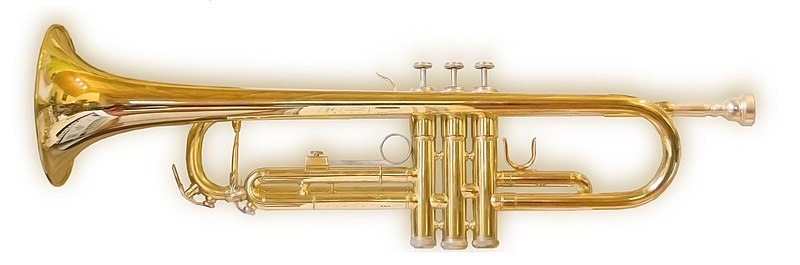
The Lord commands Moses to make two silver trumpets "of hammered work," meaning not of animal horn. So rather than looking like a traditional shofar...


[Man not included. Photos courtesy Wikipedia]

The trumpet would be all metal. Still, it would more resemble a bugle or just a straight pipe than any sort of modern valved trumpet we know today.


These trumpets are used to summon the congregation and break camp. The sound of both being blown summons the entire congregation at the entrance of the tent of meeting. The sound of one blowing summons only the leaders of the tribes. An alarm (which is different than a blow) indicates that the east side of the camp shall set out. Subsequent alarms indicate that the south should leave. It is not explicitly stated that the alarm should sound to rouse the western and northern tribes. This could be for a number of reasons:
  1. Copy error. Perhaps it was not copied from one version to the next.
  2. There in fact was no need to blow the horn. The other tribes would follow.
  3. Though a trumpet should be blown for the other sides of the tent, the biblical author felt the information was unimportant. This is the most unlikely of the three options. The bible may be laconic, but it is very specific in its instructions. One need only take a look at the account of "The Cloud and the Fire" (see description above) to understand the importance of specificity.
The trumpets shall be blown only by the priests. It is to be blown in battle "so that you may be remembered before the Lord your God and saved from your enemies" as well as on days of rejoicing, at the appointed festivals, and at the beginning of the month. The sound of the trumpet is a reminder to the Israelites that they belong to the Lord - and by extension, that God will protect them (if they are good):
"they shall serve as a reminder on your behalf before the Lord your God: I am the Lord your God" (Num 10.10).


Departure from Sinai: Numbers 10.11-36

The cloud lifts from over the tabernacle on the twentieth day of the second month of the second year after escaping Egypt. For everyone trying to keep track of time, it is 19 days after the census, and 11 months and 19 days after the Israelites arrived at the wilderness of Sinai.

The Israelites set out by stages to the wilderness of Paran, where the cloud settles down. The bible describes the Israelites setting out company by company in a passage with a lot of names and repetition - nothing we haven't seen before.

Moses tells his Midianite (i.e. not Israelite) father-in-law Hobab* that the Israelites are setting out, and asks if Reuel will come with them, for the Israelites will treat him well. Hobab responds that he will not go, but will rather return to his homeland. Moses ups the ante: The Israelites depend on Hobab for his knowledge of places to camp in the wilderness and his good eyes for seeing enemies. Moreover, if he follows them, he will be cared for as God cares for the Israelites: "whatever good the Lord does for us, the same we will do for you" (Num. 10.32). As a Midianite, Hobab cannot be holy so he is offered the next best thing: inclusion. Hobab will not receive the goodness from God, but he will get a taste of God's goodness through the Israelites.

The Israelites set out on a three-day's journey from Sinai.

The passage ends with what seems to be two battle cries:
Whenever the ark set out, Moses would say,
‘Arise, O Lord, let your enemies be scattered,
and your foes flee before you.’
And whenever it came to rest, he would say,
‘Return, O Lord of the ten thousand thousands of Israel.’
(Num. 10.35-36)
The battle cries seem predicated on the ark, which of course is God's throne, upon which the cloud of pillar and fire rests when God is with the people. The Israelites' battles are divinely sanctioned, and indeed God as divine warrior is with the people when they fight.


*The name established in Ex. 2. The man is also called Jethro in Ex. 3. The name depends on the tradition. Likewise, Mount Horeb and Mount Sinai are interchangeable, different names for the same place.


Tomorrow: It's been a while since we've heard complaining in the wilderness, right?

Thursday, August 5, 2010

Leviticus Wrap-Up

On the Bible as Literature

Leviticus was a very difficult section of the bible to cover. I was considering this as I drove up to Ithaca the other day, listening to the Interfaith Voices podcast. Lo and behold, the podcast featured an analysis of Judaism. While this blog is not about analyzing religion, it did give some excellent food for thought.


Host Maureen Fiedler spoke of the Torah:
"There are lots of laws. Anybody who's ever looked at the book of Leviticus can go blurry-eyed at the number of minute laws and regulations, many of which would have no application in the world today or some of which would appear incredibly harsh."

I hear ya. And if you've been following this blog with blurry eyes, you hear her as well. The context of the quotation fits into a discussion of Judaism as a religion of story and law. Its scripture, too, is all story and law. Leviticus just happens to be a book that concerns law. In future books I might treat this differently - I don't seem to have maintained many readers through this exercise. I don't blame anyone for dropping off. This was a difficult section for me to read and relate, and surely difficult to relate to.

In any case, Fiedler's gues, Stephen Prothero, brought up some great points in the discussion of Judaism that when tweaked can help to elucidate a reading of religious scripture as literature. Stephen Prothero is the author of God is Not One: The Eight Rival Religions that Rule the World and Why Their Differences Matter. He is also a regular contributor to the new CNN Belief Blog.

Prothero sought what problem Judaism as a religion is trying to solve, and what is the solution:
"My take on it is that Judaism is the way of exile and return. The problem is exile. The problem is that we are apart from God, apart form our community, and we have to return. We have to get back to God, get back to our community. This has antecedents in the exile of the Jews from the Promised Land, the exile of the Jews from the Temple."
This helps to explain the biblical story, and those dialectical tensions I have been writing about. The divine contract of Leviticus 26 really helps to sum up the reasons for exile. It is like the plot of the entire bible is here revealed. If humans follow God, they prosper. If they do not, they will find themselves in exile. The biblical authors set up a story of people disobeying God and then returning to worship him, just as people are exiled from a land and then return. The exile coincides with a loss of faith as the return coincides with a renewal of faith. The exile and return are the religious messages, which are derived from the messages of obedience and disobedience established in the texts.

Obedience, of course, hinges on law. Therefore there is a lot of legal material in the bible. Without these laws, the Israelites would have nothing to obey or disobey. Without these laws, there would not be cause and logic in the story. The bible is a very well-crafted piece of literature, even without a religious context.

Wednesday, August 4, 2010

Leviticus 27

Leviticus 27 / Leviticus Wrap-Up

Votive Offerings: Leviticus 27

Leviticus 27 comprises a list of instructions that continues from Leviticus 25. For modern minds, it might make sense for Leviticus 26 to be the last book of the bible, with its instructions for keeping on God's good side. However, this is not the way the authors chose to arrange the bible. The effect is such that Leviticus 27 functions like an appendix of various offerings not mentioned elsewhere.

I have to admit, I do not understand this chapter well. What does dedication get you, besides recognition by God? Is it necessary in any religious capacity? From what I have read, I would imagine that these laws go back to much older ideas...

In any case, ou may devote a number of objects to the Lord, and Leviticus 27 lists these and their accompanying directives. Enjoy these handy charts. Impress your friends!

Humans equivalencies in vows to the Lord
[That is, the equivalent amount to give as a dedication to God in lieu of a human that will do service]

Males age 20 to 66: 50 shekels silver

Females age 20 to 66: 30 shekels silver

Males age 5 to 20: 20 shekels silver
Females age 5 to 20: 10 shekels silver

Males age 1 month to 5 years: 5 shekels silver
Females age 1 month to 5 years: 3 shekels silver

Males age 60+: 15 shekels silver
Females age 60+: 10 shekels silver

Assessments for those who cannot afford a human dedication will be made by a priest on a case-by-case basis, depending on what a family can afford.


Animal offerings
Regularly sacrificed animals are holy. This holiness is nontransferrable to animals that have not been conecrated. In the case of substitution, both animals are deemed holy.

Unclean animals are assessed by a priest on a case-by-case basis, with an additional 20% tacked on.

Consecrating Houses
Assessed by a priest. It may be redeemed by the original owner with an additional 20% tacked on [a great way to make some money back if you have someone's property!].

Consecrating land
Value is based on equivalence: 50 shekels silver is equal to a homer of barley seed. The jubilee year merits special considerations. 

Misc.
Firstling clean animals cannot be consecrated. Nor can unclean animals, but these are valued by a priest with 20% added.

Everything devoted to the Lord may not be sold or redeemed. Not even humans. This is God's no-exchange policy.

Tithes of produce belong to the Lord, but may be redeemed with 20% added. The herd and flock tithes are one-tenth of the herd or flock. These may not be substituted with money.

The book ends:
These are the commandments that the Lord gave to Moses for the people of Israel on Mount Sinai.
(Lev. 27.34)
It's been a long journey. Look for tomorrow's entry - Leviticus wrap-up!

Tuesday, August 3, 2010

Letivicus 26

The Divine Contract: Leviticus 26

The story of the bible is about the relationship between God and God's people, the Israelites.

One way of measuring the relationship is through dialectical tensions - the tensions between what God wants the Israelites to do, and what they do in reality. Another way of measuring the relationship with God is through covenants. So far God has made covenants with Noah, Abraham, and Jacob/Israel. The purpose of the divine covenant established with Abraham and updated with Jacob/Israel is essentially to keep the dialectical tensions to a minimum. In other words, God's covenant is an attempt to ensure the Israelites do as God wishes. The terms are given quite simply: if the Israelites do what God requires, they will thrive. If the Israelites do no do what God requires, they will suffer. In today's selection God makes a contract with the Israelites. It is not quite a covenant, but it spells out punishments and rewards for disobeying and honoring the covenant.

The terms of this contract with Israel are quite explicit in the following passage. The contract consists of a statement of rewards for obedience, a statement of penalties for disobedience, and a message of redemption. The terms are quite eloquent, the language beautiful, so I have quoted liberally. I really do recommend reading this one on your own by clicking the "Leviticus 26" link above.

And now...the divine contract.

Rewards for Obedience: Leviticus 26.1-13
If God's statutes and commandments are observed faithfully, God will:
  • Give rain so the land will yield produce
  • ...Make that a lot of produce, as well as food and personal security: "Your threshing shall overtake the vintage, and the vintage shall overtake the sowing; you shall eat your bread to the full, and live securely in your land." (Lev. 26.5)
  • There will be peace for you in the land - no enemies or dangerous animals
  • You will kill your enemies, even outnumbered 5 to 100 or 100 to 10,000
  • You will be fruitful and multiply
  • The harvest will be so good that you will have to clear out old grain to make room for the new harvest
  • God will place God's dwelling in the midst of the people, and not abhor them
The rewards end with a reminder that forms the tail end of the envelope with Leviticus 25.55 (see above):
"I am the Lord your God who brought you out of the land of Egypt, to be their slaves no more; I have broken the bars of your yoke and made you walk erect."
(Lev. 26.13)
Penalties for Disobedience: Leviticus 26.14-46
God lists five stages of disobedience - and in so doing provides six opportunities for the Israelites to repent if they desire. The final stage of disobedience results in near-obliteration for the Israelites.

1. If the commandments and ordinances and statutes are not observed and the covenant is broken:
  • God will bring terror upon you: consumption and fever that waste the eyes, causing life to pine away
  • Your enemies will eat what you sow
  • Your enemies will rule over you
  • And you will "flee though no one pursues you"
2. If you continue to disobey:
  • God will continue to punish your sins sevenfold
  • "I will break your proud glory, and I will make your sky like iron and your earth like copper"
  • Your strength will be spent without purpose
  • Your land will not yield produce
3. If you continue to disobey:
  • God will continue to plague you sevenfold
  • Let loose wild animals that will kill your children and livestock and people ("they shall make you few in number, and your roads shall be deserted")
4. If you even then continue to disobey in spite of the punishments, God will continue to be hostile to you:
  • Continue to strike you sevenfold for your sins
  • "Bring the sword against you, executing vengeance for the covenant" [note that God is serving retribution on behalf of the broken covenant]
  • You will withdraw to your cities (due to war), only to be struck with pestilence and delivered into your enemy's hands
  • Bread, and ovens to bake it in, will become scarce, "and though you eat, you shall not be satisfied"
5. If you continue to disobey:
  • God will punish you himself ("myself") sevenfold for your sins:
  • "You shall eat the flesh of your sons, and you shall eat the flesh of your daughters" (due to lack of food)
  • God will cut down the places of worship (presumably even those dedicated to YHWH! In his fury, God would destroy the very altars devoted to him
  • "I will heap your carcasses on the carcasses of your idols"
  • I will abhor you
  • God will destroy your cities and sanctuaries and ignore sacrifices
  • The land will be devastated, so that the enemies that come to settle it are appalled
From this final disobedience, the land will finally recovery from the vile people that lived on it, and enjoy a sabbath in desolation (the ones the Israelites did not properly give it) while the Israelites are in exile. The survivors will be so faint of heart in the land of their enemies that "the sound of a driven leaf shall put them to flight, and they shall fall though no one pursues them. They shall stumble over one another, as if to escape a sword, though no one pursues" (Lev. 26.36-37). The Israelites will die out, conquered by their enemies. The survivors will languish because of their own iniquities and those of their ancestors. [This last piece emphasizes the importance of following commands so that future generations will live well.]

Redemption
If the people confess to their iniquities and those of their ancestors - and admit that they acted hostile toward God so that God acted hostile toward them - then God will remember his covenants with Abraham and Jacob, and the land.

The land is purified in its sabbath when the Israelites are in exile, making amends for their iniquities:
"Yet for all that, when they are in the land of their enemies, I will not spurn them, or abhor them so as to destroy them utterly and break my covenant with them; for I am the Lord their God; but I will remember in their favor the covenant with their ancestors whom I brought out of the land of Egypt in the sight of the nations, to be their God: I am the Lord.
(Lev. 26.44-45)
The chapter ends:
"These are the statutes and ordinances and laws that the Lord established between himself and the people of Israel on Mount Sinai through Moses."
(Lev. 26.46)

Monday, August 2, 2010

Leviticus 25

Important Years: Leviticus 25

The Sabbatical Year: Leviticus 251.-7

Every seventh year the Israelites should observe a sabbath for the land, in which there is no sowing of fields or pruning of vineyards, nor any official harvest. Anyone may eat what the land bears during that year, and what is left will go to the livestock, then the wild animals.

The sabbatical year rewrites the sabbatical year described in Exodus 23.10-13. In Exodus, the field is to lie fallow in the seventh year, but it is in order to provide food for the poor, and after them the wild animals. The author of Leviticus still offered a provision to feed the poor: the field is not to be harvested to the edge, and the gleanings of the harvest are not to be gathered. These provisions ensure that the pure have food.

The Year of Jubilee: Leviticus 25.8-55

Every 49 years (or "seven weeks of years") the Israelites are to sound a trumpet on the tenth day of the seventh month - the day of atonement. This shall mark the jubilee for the next year* and liberty shall be proclaimed for all the inhabitants of the land. There shall be no sewing or reaping. The Israelites should eat only what the field produces. In the year of the jubilee every person should return his property.

[*There is debate over whether the cycle is 49 years or 50 years.]

The year of the jubilee sets a date by which economic transactions may be determined. You should pay for harvests from another person's field from the date they lay fallow - namely, the jubilee year.

Since the 49th year will be a sabbath year, the harvest in the 48th will be equal to three years' crops, to provide for the 48th, 59th, and 50th.

Land Ownership
Since land ownership is such an important feature of the jubilee year, it is no surprise that general regulations are provided here. The year of the jubilee serves as a sign that the land belongs to God, and the Israelites are only tenants. Do any business people read this blog? You might find this interesting...

If a kin member falls into debt and sells a piece of property, the next of kin should redeem it. This keeps the property within the family. If the person does not find a redeemer, but prospers and is able to do so himself, the property should be returned and the value of the property over the years should be given to the original buyer. If there is no redeemer, and the person cannot redeem the property, the property shall be returned during the jubilee. That's an interesting bit of social law - property comes back to you every 49 years for a sort of second chance. Of course, who knows if you would be alive by then, or if your family would live in the same place. In all likelihood, you would only see one jubilee in your lifetime. But still, the implications of continual ownership (excluding God's, of course) is an interesting proposition.

A house sold in a walled city may be redeemed for a year after its sale. If not redeemed it becomes the property of the buyer and will not be returned at the jubilee. Houses in unwalled towns may be redeemed, as may be the houses of the Levites, which are in actuality the collective property of all Israel. The land of the Levites, however, may never be sold.

You shall help your next of kin who fall into financial difficulties, but shall not profit financially in supporting them. They shall live as a resident alien.

Any Israelite dependent on you who becomes so impoverished that they sell themselves to you shall serve as a hired laborer, not a slave, until the jubilee, when they and their families will be free. After all, the Israelite's are the servants of God, who brought them out of Egypt. The Israelites do not own one another.

Male and female slaves may not be Israelites. They may be inherited by your children as property.

Resident aliens who encounter financial difficulties and sell themselves to other resident aliens may be redeemed by a family member (brother, uncle, cousin, etc.). The price of the sale shall be based on the amount of time until the next jubilee. Resident aliens may not treat hired resident aliens harshly, just as Israelites shall not treat hired Israelites harshly. The hired resident alien and his family shall be freed in the jubilee year.

Isn't that some interesting social justice?

Sunday, August 1, 2010

Leviticus 23-24

Festivals / Miscellaneous

Today's reading is divided into two parts. The first part concerns the various festivals of the Israelites. The second part concerns miscellaneous regulations.

Festivals: Leviticus 23

The Lord speaks to Moses, telling him to inform the Israelites of the appointed festivals of the Lord...

The Sabbath, Passover, and Unleavened Bread: Leviticus 23.1-8
The sabbath is the seventh day of the week and no work should be done on it.

Families should make a passover offering to the Lord on the evening of the fourteenth day of the first month of the year. The fifteenth day marks the beginning of the week-long festival of unleavened bread. Each day offerings by fire should be made to the Lord. A holy convocation should be held on the first and seventh day, and no one should work at his occupation on these days.

The Offering of First Fruits: Leviticus 23.9-14
When the Israelites enter Canaan, they are to bring a sheaf of the first fruits of the harvest to the priest. The pries will raise the sheaf before the Lord on the day after the sabbath, in order to gain acceptance. On this day, a year-old lamb without blemish should be sacrificed as a burnt offering, along with a grain offering and drink offering. The Lord commands that the Israelites "shall eat no bread or parched grain or fresh ears until that very day" (Lev. 23.14).

The Festival of Weeks: Leviticus 23.15-22
A second festival will occur seven weeks after the day of the elevation offering of the sheaf - 50 days after the sabbath. This shall consist of two loaves of leavened bread as first fruits. Seven one-year-old lambs, a young bull, and two rams should be offered alongside, as well as a drink offering.

One male goat should be offered as a sin offering, and two male lambs as a sacrifice of well-being. These shall all be raised with the bread as an elevation offering.

On this day no one should do work

A previously stated commandment then appears in the midst of festival descriptions: fields should not be reaped to the edges and the gleanings should be left for the poor.

The Festival of Trumpets: Leviticus 23.23-25

On the first day of the seventh month the Israelites should observe a day of complete rest, commemorated by trumpet blasts. Offerings to the Lord are still required, though unnamed.

The Day of Atonement: Leviticus 23.26-32
The tenth day of the seventh month is the day of atonement (actually, starting the evening of the ninth day and ending the evening of the tenth day). People are to do no work and fast the entire day to make atonement before the Lord. Those that do not fast will be cut off, and those that work will be killed by God.

The Festival of Booths: Leviticus 23.33-44
The fifteenth day of the seventh month marks the first day of the week-long festival of booths. The first and eighth days are days of holy convocation; no one should work. On the first day the Israelites should take fruit, palm branches, and boughs of leafy trees and willows, and rejoice before the Lord for seven days.

For this week the congregation is to live in booths as a reminder that the Israelites lived in booths when they were first brought out of Egypt.

Miscellaneous: Leviticus 24

The Lamp: Leviticus 24.1-4

The people of Israel are to provide pure olive oil so the lamp may be kept burning regularly from dusk until dawn. Aaron should set the lamp up in the tent of meeting, outside the curtain of the covenant, so that it burns "before the Lord."

The Bread for the Tabernacle: Leviticus 24.5-9

The bread of the tabernacle consists of twelve loaves (one for each tribe of Israel), each made with 2/10 ephah of choice flower. The loaves should be arranged in 2 rows of six on a table of pure gold. Frankincense should be put with each row as an offering by fire.

Every sabbath Aaron shall arrange the loaves thus to show the commitment of the people of Israel. Aaron and his family may eat them in a holy place.

Blasphemy and Its Punishment: Leviticus 23.10-23

This set of instructions differs from much of Leviticus in that an anecdote of the crime is given, which prompts an explanation of the penalty. Throughout the rest, there has been little narrative in explanation of laws. The story goes like this:

Shelomith, daughter of Dibri, of the tribe of Dan, has a son. One day the son is speaking with a man whose father is an Egyptian. They begin to fight, and the Israelite son curses the Egyptian, uttering the divine name in the process (the Tetragrammaton; YHWH). The Israelite is brought to Moses and put into custody until a decision comes from the Lord.

The Lord tells Moses to take the blasphemer out of the camp, where those who heard him should lay their hands on his head, while the rest of the congregation stones him. (The laying of hands served to transfer the sin from the blasphemy back to its source, much as a priest transfers sin to a sacrifice.)

God commands Moses to speak to the people of Israel: Anyone who blasphemes shall be stoned by the entire congregation. The law applies to both aliens and citizens.

God gives further commandments regarding death and injury, these applying to alien and citizen alike. Anyone who kills a human being should be put to death. Injuries should be dealt with in kind, "fracture for fracture, eye for eye, tooth for tooth; the injury inflicted is the injury to be suffered" (Lev. 24.20).  Anyone who kills an animal should make restitution, but anyone who kills a human or blasphemes God should be killed.

We're getting to the end of Leviticus. Tomorrow: Time, time, time.

Saturday, July 31, 2010

Leviticus 21.1-22.33

The Holiness of Priests / The Use of Holy Offerings / Acceptable Offerings

You know that old saying "cleanliness is next to godliness?" Well that certainly applies to today's reading (and, in fact, many of the past readings as well). Holiness, as mentioned before, is a state of separation from the "other." One is not holy because one believes in God. Rather, one is holy because one carries out all of God's commandments correctly. That is why the law books are contained within the bible - to show how to be holy in the eyes of God.

In many cases holiness is separation from uncleanliness. Anything that can defile you physically or mentally is to be avoided. You are to have a clean mind and body. The priests (Aaron's sons) must be exceptionally clean, as they act between intermediaries between God - the most holy - and the people - who aren't as holy. Furthermore, the head priest must be the cleanest, most holy member of the priesthood, as he deals the most directly with God. Cleanliness here is quite literally next to godliness.

How do we read these commandments for cleanliness/holiness as literature? There are a number of ways, but today I will analyze the power structures within Israelite religion as the Israelites wander in the desert. These power structures are based on a hierarchy of holiness, which favors certain people over one another, but overall attempts to ensure that all the people of Israel are sufficiently acceptable (holy) in the eyes of God.

The Holiness of Priests: Leviticus 21.1-24

This chapter is comprised of commandments for the priests only.

Priests are to be kept away from death. They defile themselves for coming into contact with anyone but their immediate family: father, mother, brother, son, daughter, and virgin sister. The sister must be a virgin in accordance with a biblical "sex marriage economy," which treats women as property that drops in value with the loss of virginity. A virgin sister would not be married, and therefore is still the property of her father. Her priest brother may therefore bury her. As soon as she is married she becomes the property of another man, and she may no longer be buried by her priest brother.

The priest cannot bury his wife either, and I am inclined to believe this is because she is not necessarily from the same family. The head priest must marry a member of his family (though outside of the ring of incest), but the other priests have no such prohibition. In this case, the wife has roots elsewhere and therefore should be buried by her own family.

As in the last post, priests may not display mourning by cutting their hair, shaving their beards at the edges, or scaring their flesh.

The scripture continues:
They shall be holy to their God, and not profane the name of their God; for they offer the Lord’s offerings by fire, the food of their God; therefore they shall be holy. They shall not marry a prostitute or a woman who has been defiled; neither shall they marry a woman divorced from her husband. For they are holy to their God, and you shall treat them as holy, since they offer the food of your God; they shall be holy to you, for I the Lord, I who sanctify you, am holy. When the daughter of a priest profanes herself through prostitution, she profanes her father; she shall be burned to death.
(Lev. 21.6-9)
I am going to break this down into two parts. First, notice the two sections marked in red. They essentially say the same thing, right? This is referred to as an inclusio, a narrative unit in which the beginning and end are marked off by a key phrase. It's kind of like envelope structure, though envelope structure can span over many verses, even over a chapter. It might be difficult to tell from the analysis I have given, but actually this inclusio shifts the audience from Moses to Israel as a whole. The opening of the inclusio speaks generally of the priests, but the closing directly addresses the Israelites: "they shall be holy to you." That's some ancient editing you're seeing there. Pretty cool, right?

Second, notice the appearance of the biblical sex marriage economy. The value of a woman is not monetary, but symbolic. Women who have prostituted themselves or been married or raped are not suitable for priests - their previous sexual experience lowers their value in the economy. Her status as a virgin, however, is not explicated. Furthermore, a priest's daughter is to remain pure, and as the property of her father, she profanes her father through prostitution. The way to rectify this profanity is to completely remove all traces of the daughter through incineration, thereby removing the guilt and the potential for more guilt. No animal sacrifice is required, to expiate the sin that is brought on the priest father, and her death in imitation of sacrifice removes the guilt from him.

The high priest is not allowed to mourn at all for anyone. He shall not encounter a dead body, even that of his mother or father. He shall not leave the sanctuary as he will track in unholiness when he returns. He is to only marry a virgin, the most valuable object in the sex marriage economy. The woman must be of his own kin, presumably so that the priestly line remains pure.

Though Aaron's family receives the meat and grain of sacrifice, not everyone qualifies in making the actual sacrifice to God. Anyone who is blemished may not make a sacrifice to God. That is, these people are not holy enough - not far enough from the common people and not close enough to God. These people may eat the food - indeed, it is their only food source, but they may not approach the altar or make sacrifice. Doing so would profane the sanctuary. Here are the explicit blemishes that will prevent a member of Aaron's family from making sacrifice:
  • Blindness
  • Lameness
  • Mutilated face
  • Possessing a limb that is too long
  • Broken foot
  • Broken hand
  • Hunchback
  • Dwarfism
  • Blemish in the eye
  • Itching disease
  • Scabs (skin disease)
  • Crushed testicles
These conditions prevent a descendant of Aaron from making sacrifice in order to keep the altar, and therefore the people of Israel, pure.

The Use of Holy Offerings: Leviticus 22.1.16

In order to avoid profaning themselves, the priests must make offerings in a very specific manner. Any unclean person who encroaches upon the sacred donations will be cut off from God's presence. In addition to the prohibitions of sacrifice above, any of Aaron's relatives with a skin disease or a discharge may not eat sacrificed meat or grain until he is clean. Conditions which sully a person for a day - such as contact with a corpse, an emission of semen, or touching an unclean animal or human - require the person to wash himself and wait until the sun sets before eating, when he will be clean. Priests may not eat meat of animals that died of natural causes or that was killed by wild animals. Eating such meat is condoned for laypeople.

Only those in the priest's family may eat of the sacred donations. Laypeople may not eat of the sacred donations, except for purchased slaves. If a priest's daughter marries a layman, she may not eat of the sacrificed food. This is due to her becoming the property of a layperson by the sex marriage economy. Her status is lowered so that she may not partake of the sacrificed food. However, if she is widowed or divorced without offspring, she may again eat of the sacred donations, as she has returned to her original state of property of her father.

If a layperson does eat of the sacred donation unintentionally, he is to add one-fifth to its value and give the donation to the priest.

If a priest profanes the sacred donation, he is required to make a guilt offering.

Acceptable Offerings: Leviticus 22.17-33

The rigid requirements for sacrifices are nearly as stringent as for those who may make sacrifice. And in fact, many of the laws regarding sacrifice parallel laws governing humans.

An offering in payment of a vow or as a freewill offering that is taken and slaughtered and burnt by a priest must be a male without blemish. The animal may be cattle, a sheep, or a goat. It must be perfect. Here are some of the characteristics that would preclude a goat from being sacrificed. Those characteristics shared with humans that cannot make sacrifices are highlighted in red.
  • Blind
  • Injury
  • Maiming
  • Discharge
  • Itching disease
  • Scabs (Skin disease)
  • Bruised or crushed or torn or cut testicles
  • Animals from foreigners (blemished by their very nature)
An ox or lamb with a limb too long or too short is acceptable as a freewill offering, but not for a vow.

These prohibitions of the animals that can be sacrificed parallel the prohibitions of people that may offer sacrifice because the Lord requires a high level of holiness. These are apparently the ways in which unholiness manifests itself.

Another parallel is that an ox or sheep or goat should remain with its mother seven days after its birth. It may be burned on the eighth day. This plays off of the circumcision commandment, in which the child remains in a state of flux for seven days before its circumcision, when it officially joins the covenant that God has established with the Israelites. Likewise for livestock, it is only on the eighth day that the newborn animal may be sacrificed to God.

More rules: The mother may not be slaughtered on the same day as its offspring. Thanksgiving offerings must be eaten on the day of slaughter.

The chapter ends with a reminder to the Israelites of where they have come from and whose commandments they are obeying:
Thus you shall keep my commandments and observe them: I am the Lord. 32You shall not profane my holy name, that I may be sanctified among the people of Israel: I am the Lord; I sanctify you, 33I who brought you out of the land of Egypt to be your God: I am the Lord.
(Lev 22.31-33)

Friday, July 30, 2010

Leviticus 19.1-20.27

Ritual and Moral Holiness / Penalties for Violations of Holiness

These commandments by today's standards are sexist, insensitive to other peoples, and anti-gay. The world was a different place back then. It was probably inhabited by the same sorts of people, though...

And yet, let me get philosophical here. I have been reading articles on ChristWire.org, at first because they are so gosh-darn ignorant, but then more because they horrify me and I desired to understand how people could actually believe these frequently racist and backward notions. I am no stranger to hate speech on the Internet - I wrote a semester-long paper on the politics of white supremacists and the "9/11 truth" movement back in my freshman year of college. But I am still taken aback every time I see the ignorant vitriol spewed on these web sites.

Some people have issues with the bible because of its commandments, and I know that I am getting bogged down in law. I would love to get to some narrative elements. But to me, this is important stuff to read in order to understand how the biblical authors thought and what was important to them. Yes, I am reading the book as literature, but it is very difficult, perhaps impossible, to read anything without bringing your own ideology into it.

Ritual and Moral Holiness: Leviticus 19.1-37

Here are some rules that Lord gives to Moses to give to the congregation of Israel. It all starts out with a recap of the guiding ideas of the ten commandments:
You shall be holy, for I the Lord your God am holy. You shall each revere your mother and father, and you shall keep my sabbaths: I am the Lord your God. Do not turn to idols or make cast images for yourselves: I am the Lord your God.
(Lev. 19.2-4)
"I am the Lord" and "I am the Lord your God" serve as a refrain for this section, demarcating rules. They shall henceforth be referred to as "IL" and "ILYG."
  • Make your sacrifice of well-being acceptable. Eat it within two days or burn it on the third. Eating it on the third day profanes what is holy to the Lord and will cause you to be cut off.
  • Do not reap to the edge of the field, or gather your cleanings, or strip the vineyard bare, or gather its fallen grapes. The fruits of these are for the poor and alien. ILYG. [Divine sanctioned welfare?]
  • Do not steal, deal falsely, lie, or swear falsely by God's name. IL.
  • Do not rob or defraud or neighbor or deny the wages of a laborer until morning. Do not revile the deaf or put a stumbling block before the blind [!]. Fear the Lord. IL.
  • Be fair in your judgment. Don't be partial to the poor or defer to the great. Don't slander. Protect your neighbor if he is in trouble. IL.
  • Don't hate your family members. Reprove your neighbor if he needs it. Don't take vengeance or bear grudges. Love your neighbor as yourself. IL.
The following lack a closing tag of IL or ILYG:
  • Keep God's statutes. [The following cover holiness, or separateness] Don't let your animals breed with a different kind. Don't sow two types of seed in the same field. Don't wear a garment made of two different materials.
  • If a man has sexual relations with a slave woman who is designated for another but is not free or ransomed, an inquiry will be held. Since she is not free, they will not be put to death. But the man should offer a ram as a guilt offering.
We again resume with the laws demarcated with IL and ILYG:
  • Once in Canaan, the Israelites should regard the fruit trees of the foreign peoples "as their uncircumcision" for three years, which basically means "don't eat it."In the forth year it should be set apart for the Lord (again, don't eat it.) In the fifth year, you may eat the fruit, which will be more abundant. ILYG.
  • Do not eat flesh with blood. Do not practice augury or witchcraft. Don't round off your hair at the temples or trim the edges of your beard. Do not mark yourself with tattoos or scars. [These last three keep the Israelites separate in appearance from their neighbors.] IL.
  • Don't make your daughter a prostitute. Keep the sabbaths. Revere God's sanctuary. IL.
  • Do not seek out mediums or wizards. ILYG.
  • Defer to the old, and rise before them, and fear your God. IL.
  • Do not oppress aliens residing in your land. Love the aliens as yourself as you were an alien in Egypt. ILYG.
  • Keep your measurements, weights, and balances honest. IL ["who brought you out of Egypt"].
Penalties for Violations of Holiness: Leviticus 20.1-27
  • If an Israelite or alien living with the Israelites gives his offspring to Moloch, that person should be stoned to death. God himself will further cut that person off from ("set my face against") the people, because that person has defiled the holy name. Those that turn a blind eye to child sacrifice will also be cut off, along with their families.
  • God will set his face against those that turn to mediums and wizards. Therefore the Israelites should sanctify themselves and be holy. The Lord will sanctify the people if they obey the commandments.
  • Those who curse their parents should be put to death.
Sexual situations in which both guilty parties will be put to death (it is assumed this applies to males):
  • Adultery (man and the wife of his neighbor)
  • Incest (man and his father's wife)
  • Sex with a daughter-in-law (man and daughter-in-law)
  • Male homosexual sex (both parties)
  • Sex with both a woman and her mother (all three, by burning)
  • Bestiality (applies to man and woman, raped animal dies as well)
Sexual situations in which both parties are cut off from the people but not killed:
  • Incest (with sister or half-sister)
  • Sex during a woman's menstruation or any other discharge
Other sexual situations:
  • Sex with aunt by blood (punishment is not specified, but affects both parties)
  • Sex with aunt by marriage (both guilty parties will die childless)
  • Sex with a sister-in-law (both guilty parties will die childless)
These practices separate the Israelites from the nations that precede them in the land of Canaan. Observing these will keep the Israelites safe in the land "flowing with milk and honey."

And then we get a pretty good definition of what "holiness" is:
I am the Lord your God; I have separated you from the peoples. You shall therefore make a distinction between the clean animal and the unclean, and between the unclean bird and the clean; you shall not bring abomination on yourselves by animal or by bird or by anything with which the ground teems, which I have set apart for you to hold unclean. You shall be holy to me; for I the Lord am holy, and I have separated you from the other peoples to be mine.
(Lev. 20.24-26)
It is separation that defines holiness.

Then appears a random commandment to close off the chapter: Wizards and mediums should be stoned to death.